5G Phone Specifications Explained: Bands, Speed, and Compatibility
📶 5G Phone Specifications Explained: Bands, Speed & Compatibility – 2026 Complete Guide
When you buy a new phone today, you see "5G" written in large letters on the box. But did you know there are multiple types of 5G networks? And that your phone might not work on 5G in another country? In this guide, we explain everything you need to know about fifth-generation technology.
5G isn't just about higher speeds—it's a quantum leap in telecommunications. But to understand it properly, we need to learn about frequency bands, different network types, and how to check compatibility with local and international 5G networks.
📡 1. What are 5G Bands? (And Why They Matter)
5G bands are the frequencies used by fifth-generation networks to transmit data. Think of each band as a "lane" on a highway. The more lanes your phone supports, the better it can travel at high speeds in different conditions.
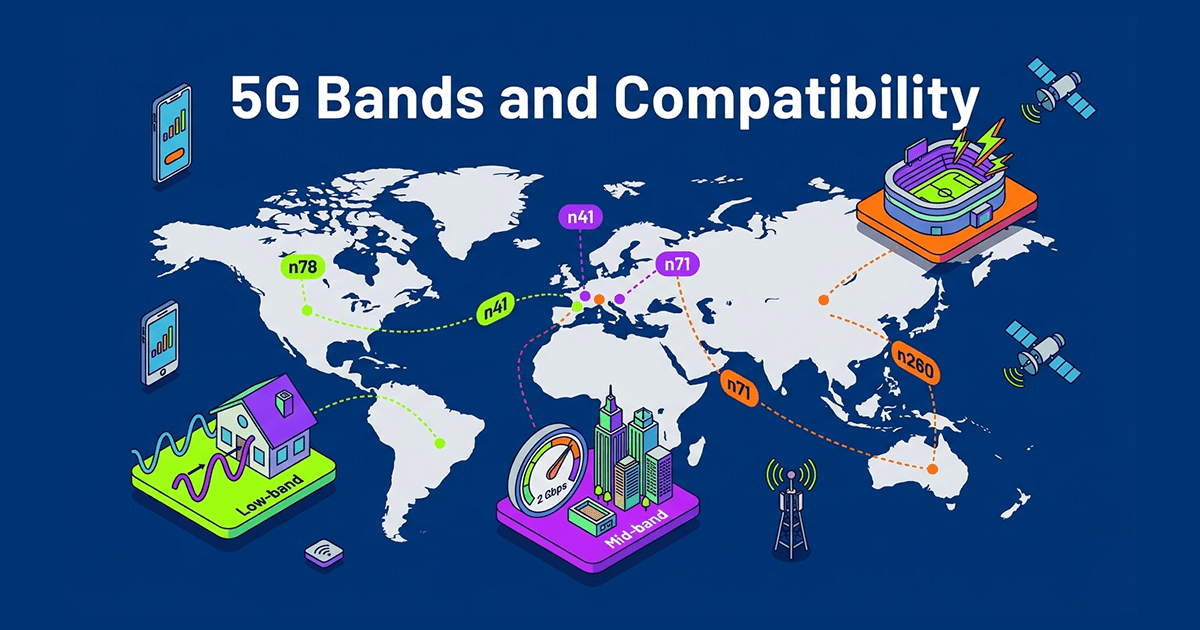
Each band is coded with a number starting with "n" like n78, n41, n71. Some bands are global and used in most countries, while others are specific to certain regions or carriers.
📊 2. The Three Types of 5G Networks
There isn't just one 5G network. There are three main types, each with different uses and characteristics.
| Type | Frequency | Speed | Coverage | Use Case |
|---|---|---|---|---|
| 📶 Low-band | 600-900 MHz | 🟡 Medium (~50-400 Mbps) | 🟢 Very wide, penetrates walls | Rural & nationwide coverage |
| ⚡ Mid-band (C-band) | 1-6 GHz | 🟢 Fast (~1-2 Gbps) | 🟡 Medium, less penetration | Urban & suburban "sweet spot" |
| 🚀 High-band (mmWave) | 24-47 GHz | 🔴 Ultra-fast (~4-10 Gbps) | 🔴 Very limited, line-of-sight | Stadiums, airports, dense areas |
📶 Low-band 5G
Operates below 1 GHz (e.g., n71 at 600MHz, 700MHz band for wide coverage ). Provides extensive coverage similar to 4G, penetrating walls easily. However, speeds aren't much higher than 4G (around 50-400 Mbps). Used by carriers like T-Mobile for rural areas.
⚡ Mid-band 5G (C-band)
This is the 5G "sweet spot." It operates between 1-6 GHz, with the most famous being n78 (3.3-3.8 GHz), n77, and n41. It offers an excellent balance between speed and coverage, and is the most widely deployed globally. C-band (3.7-3.98 GHz in the US) is a subset of mid-band that's crucial for 5G rollout.
🚀 High-band (mmWave)
Operates above 24 GHz (e.g., n258, n260, n261). Delivers incredible speeds up to 10 Gbps, but is extremely sensitive to obstacles—even a tree or window can block the signal. Used in crowded places like stadiums. mmWave frequencies range from 24GHz to 52.6GHz in 5G NR FR2.
🌍 3. Most Common Global 5G Bands
According to global network analysis, certain bands have become "standards" in most countries:
- 🔹 n78 (3.3-3.8 GHz): The most widely used band globally, supported by over 150 operators worldwide (C-band/mid-band).
- 🔹 n28 (700 MHz): Low-band providing wide coverage, used in Europe and Asia for rural 5G.
- 🔹 n41 (2.5 GHz): Mid-band heavily used in China and the US.
- 🔹 n1 (2100 MHz): Mid-band repurposed from 3G networks.
- 🔹 n77 (3.3-4.2 GHz): Similar to n78, used in many regions.
- 🔹 n258/n260/n261: mmWave bands used primarily in the US.
🗺️ 4. Bands by Region and Carrier
🇺🇸 United States
Each US carrier has its own mix of bands:
- AT&T: n5, n66, n2, n77, n260. Calls their mmWave "5G+".
- T-Mobile: n71 (600MHz low-band), n41 (2.5GHz mid-band), n66, n25, n77, n258, n261. Uses "layer cake" approach with all bands.
- Verizon: n5, n66, n2, n77, n48, n260. Calls their mmWave "5G Ultra Wideband".
🇪🇺 Europe
Europe primarily uses n78 (C-band, 3.4-3.8 GHz) for urban coverage and n28 (700 MHz) for rural and indoor coverage. The 700MHz rollout is planned across 2026-2027 to achieve 100% coverage at lower speeds (~50Mbps).
🇨🇳 China
China uses a mix: n41 and n28 shared by China Mobile and China Broadcasting Network, and n1 and n78 shared by China Telecom and China Unicom.
🌏 Other Regions
Qatar's 2026 Frequency Allocation Plan identifies the 6425–7125 MHz band for IMT and mmWave bands 24.25–27.5 GHz and 66–71 GHz. Indonesia added 2.6 GHz for 5G in 2026.
✅ 5. How to Check Your Phone's 5G Compatibility
🔍 Step 1: Find your phone's supported bands
Visit Mobolist or the manufacturer's official website. Search for your phone model and look for "Network" or "5G Bands." You'll see a list like:
5G: n1, n3, n5, n7, n8, n20, n28, n38, n40, n41, n48, n66, n77, n78, n79
🔍 Step 2: Find your local carrier's bands
Search for "5G bands supported by [your carrier name]." Most carriers publish this information on their official websites.
🔍 Step 3: Compare the two lists
If there's at least one matching band, your phone will work on that carrier's 5G network. The more matching bands, the better the experience.
💎 Golden Rule: When buying a phone from abroad, make sure it supports your local bands. Some phones designed for specific markets may not support the bands used in your region.
⚡ 6. Why 5G Speed Varies by Location
Speed depends on several factors:
- Band type: mmWave is fastest but rare, C-band is fast, low-band is slower.
- Network congestion: Speeds drop in crowded areas.
- Distance from tower: The farther you are, the slower the speed.
- Obstacles: Buildings and trees affect signals, especially at higher frequencies.
🧠 7. Advanced 5G Technologies
📡 Dynamic Spectrum Sharing (DSS)
Allows carriers to use the same frequencies for both 4G and 5G simultaneously, helping expand 5G coverage without needing new spectrum.
📡 Massive MIMO
Using dozens of antennas at once to precisely direct signals to devices, increasing efficiency and speed.
📡 Beamforming
Focusing the radio signal directly at the user's device rather than broadcasting in all directions, improving range and speed for mmWave.
📡 Network Slicing
Dividing the network into virtual "slices," each dedicated to specific applications (e.g., one slice for autonomous cars, another for regular phones).
❓ 8. Frequently Asked Questions
Q: Can I use a 5G phone bought abroad in my country?
A: It depends on the bands your phone supports. Compare your phone's bands with your local carrier's bands.
Q: What's the difference between Sub-6 and mmWave?
A: Sub-6 includes low and mid bands (under 6 GHz) and provides wide coverage. mmWave includes very high bands (over 24 GHz) and provides extremely high speeds but over short distances.
Q: Why does the 5G icon show but my speed is slow?
A: You might be connected to low-band 5G, which isn't much faster than 4G, or the network might be congested.
Q: Do I need a phone that supports mmWave?
A: Outside the US, most countries rely on Sub-6. You may not need mmWave unless you travel to areas that support it.
Q: Is C-band the same as mid-band?
A: C-band (3.7-3.98 GHz in the US) is a subset of mid-band frequencies. It's considered the "sweet spot" for 5G.
Understanding 5G bands is the key to truly benefiting from fifth-generation technology. Before buying your next phone, check the bands it supports and ensure compatibility with your local network. Knowledge is power—and in telecommunications, knowing bands means stronger, faster connectivity. 📱✨