Storage Specs Compared: UFS 2.2 vs UFS 3.1 vs UFS 4.0 vs UFS 4.1 Pro (Complete Guide)
⚡ Internal Storage in Smartphones and Tablets Explained: UFS Versions Comparison
Ever wondered why your new phone opens apps lightning-fast while your friend's phone (with the same processor and RAM) feels noticeably slower? The secret is often in the internal storage type (UFS). In this comprehensive comparison, we'll reveal the real differences between UFS 2.2, UFS 3.1, UFS 4.0, and the latest UFS 4.1 Pro, and how they affect your daily experience.
📚 1. What is UFS Storage Standard?
UFS stands for Universal Flash Storage, a modern data storage standard for smartphones and mobile devices, featuring very high read/write speeds compared to older standards like eMMC. The higher the version number (e.g., UFS 4.1 vs 3.1), the faster the data transfer speeds and better power efficiency, meaning faster app opening, lag-free 4K/8K recording, and smoother gaming experiences.
📊 2. Quick Comparison Table: Speeds & Key Specs
| Standard | Peak Read Speed | Peak Write Speed | Power Efficiency | Year |
|---|---|---|---|---|
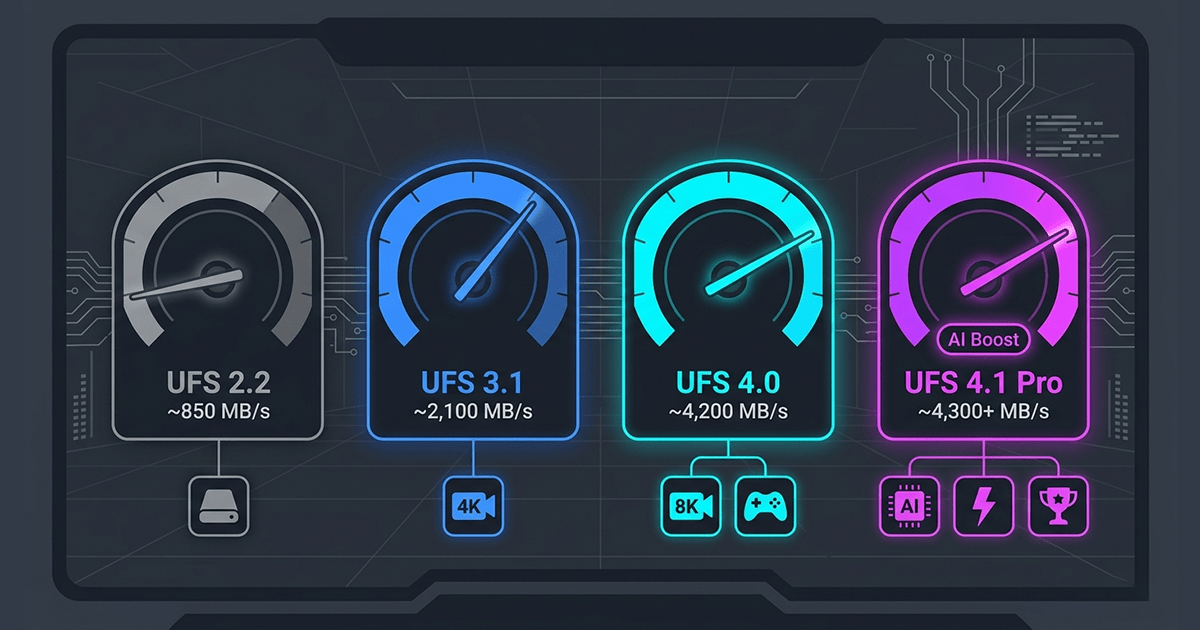
| UFS 2.2 | ~850 MB/s | ~250-500 MB/s | 🟡 Baseline | 2020 |
| UFS 3.1 | ~2,100 MB/s | ~1,200 MB/s | 🟢 Improved | 2020-2025 |
| UFS 4.0 | ~4,200 MB/s | ~2,800 MB/s | 🟢 46% better than 3.1 | 2022-2025 |
| UFS 4.1 / Pro | ~4,300+ MB/s | ~4,300 MB/s | 🟢 15-20% better than 4.0 | 2025-2026 |
📱 3. UFS 2.2 – The Budget Choice
Found in budget and lower-mid-range phones. Features WriteBooster technology improving write speeds over older versions, but still much slower than newer standards. Max read ~850 MB/s, write ~250-500 MB/s.
✅ Good for: Browsing, social media, light apps.
❌ Not for: 4K video recording, heavy gaming, video editing.
⚡ 4. UFS 3.1 – The Game-Changer
This standard revolutionized smartphones, introduced alongside 5G and heavy gaming. Read speeds up to ~2,100 MB/s, write ~1,200 MB/s. WriteBooster works more efficiently here, plus "Deep Sleep" power saving. Even today, UFS 3.1 is "more than enough" for 95% of users, found in upper-mid-range and older flagship phones.
🚀 5. UFS 4.0 – Modern Flagship Standard
Debuted with phones like Samsung Galaxy S23 Ultra. Read speed ~4,200 MB/s (double UFS 3.1), write ~2,800 MB/s. 46% better power efficiency. This allows smooth 8K video recording, loading heavy apps in seconds, and playing next-gen games like Genshin Impact at max settings without any waiting.
✨ 6. UFS 4.1 Pro – Latest & Fastest for AI Era (2025-2026)
The newest generation appearing in 2026 phones like ROG Phone 9, iPhone 17 Pro Max, and RedMagic 11 Pro. Read speeds exceed 4,300 MB/s, but the key improvement is in random read/write speeds, improved by 15-40%. New smart features include:
- Intelligent Data Defrag: Improves read speed by up to 60% on cluttered devices.
- Pinned WriteBooster: Boosts random read speed by 30% for frequently used apps.
- Zoned Storage: Organizes data more efficiently for faster access.
This standard is specifically designed to run on-device AI applications smoothly.
🎮 7. Impact on Gaming & Heavy Apps
The difference between UFS 2.2 and UFS 4.1 Pro in gaming is massive. With UFS 2.2, Genshin Impact might take 45 seconds to load the open world; with UFS 4.1 Pro, it could drop to under 8 seconds. More importantly, random speeds affect in-game navigation and camera movement. Faster UFS means less stutter while playing.
🔋 8. Power Efficiency: The Hidden Difference
UFS 4.0 and 4.1 are up to 46% more power-efficient than UFS 3.1, meaning better battery life when downloading large files or recording video. 4.1 adds another 15-20% efficiency, extending battery life during intensive use.
💰 9. Buying Guide: Which Standard Fits Your Budget?
- Under $250: Usually UFS 2.2, acceptable for basic daily use.
- $250-$500: Look for UFS 3.1. Best value for performance.
- $500-$800: UFS 4.0 is the minimum in this range.
- $800+ (2026): Should come with UFS 4.1 Pro to be future-proof for AI applications.
📈 10. Future of Storage: Beyond UFS 4.1
The next standard is UFS 5.0, announced in late 2025, expected to reach phones in 2027-2028. Speeds may reach ~10,000 MB/s (10 GB/s), surpassing average PC NVMe SSDs!
In short, UFS storage is the "highway" inside your phone. Choosing the right standard might be more important than choosing the processor itself in some scenarios. If you're buying a phone in 2026, don't accept less than UFS 3.1. If your budget allows, go straight to UFS 4.0 or 4.1 Pro for a truly future-proof experience.