CPU vs GPU vs NPU in Smartphones: What Does Each Processor Do? - Complete Guide
🧠 CPU vs GPU vs NPU in Smartphones: What's the Difference and What Does Each Processor Do?
When buying a new phone, you encounter terms like "octa-core processor," "graphics processor," or "neural processing unit." But what's the difference between CPU, GPU, and NPU? Are they just marketing names, or does each have a completely different function? In this guide, we'll explain in plain language how each processor works, when each is used, and how they cooperate to deliver a smooth phone experience.
🧠 1. CPU (Central Processing Unit): The Mastermind of the Phone
The CPU is the beating heart of your phone. It is responsible for running the operating system, executing app instructions, and coordinating all device components. Simply put, it's what makes your phone "work."
How does it work? The CPU relies on a limited number of powerful cores designed to handle complex, sequential tasks at high speed. It's excellent at multitasking but not ideal for processing massive amounts of simple, repetitive calculations simultaneously.
What does it do on your phone? Almost everything: opening apps, browsing the web, writing messages, playing music, and managing network connections. It's the "general manager" overseeing every operation.
🎨 2. GPU (Graphics Processing Unit): Master of Gaming and Graphics
The GPU is specifically designed to handle calculations related to graphics and visual rendering. It is responsible for smooth gaming and high-definition video playback.
How does it work? Unlike the CPU, the GPU contains hundreds or thousands of small cores that work together in parallel. This makes it ideal for processing millions of pixels simultaneously to form the image you see on the screen.
What does it do on your phone? Running 3D games smoothly, playing videos, editing photos, and rendering visual effects in the system interface.
🧬 3. NPU (Neural Processing Unit): The AI Genius
The NPU is the newest addition to the phone processor family. It is designed specifically to accelerate artificial intelligence and machine learning tasks. It's the secret behind the smart features we now see in our phones.
How does it work? The NPU is optimized for specific calculations related to neural networks, such as matrix multiplication and convolution. These operations are the foundation of deep learning algorithms. Crucially, it does this with much lower power consumption than the CPU or GPU.
What does it do on your phone? Smart camera features (scene recognition, portrait mode), real-time translation, audio processing and noise cancellation in calls, and facial recognition. All these tasks are processed securely on your device without sending your data to the cloud.
⚖️ 4. Quick Comparison of the Three Roles
| Feature | CPU | GPU | NPU |
|---|---|---|---|
| Primary Function | General computing, executing instructions, coordinating system | Graphics processing, visual rendering, parallel computing | Accelerating AI and machine learning tasks |
| Internal Design | Few powerful cores | Thousands of small cores | Circuits specialized for neural networks |
| Ideal Task Type | Sequential, complex tasks | Massive parallel tasks | Matrix and convolution operations for AI |
| Power Consumption | Moderate | High | Very low |
| Key Applications | Running apps, operating system | Gaming, video, photo editing | Smart camera features, translation, voice recognition |
🤝 5. Teamwork: Why You Need All Three Together
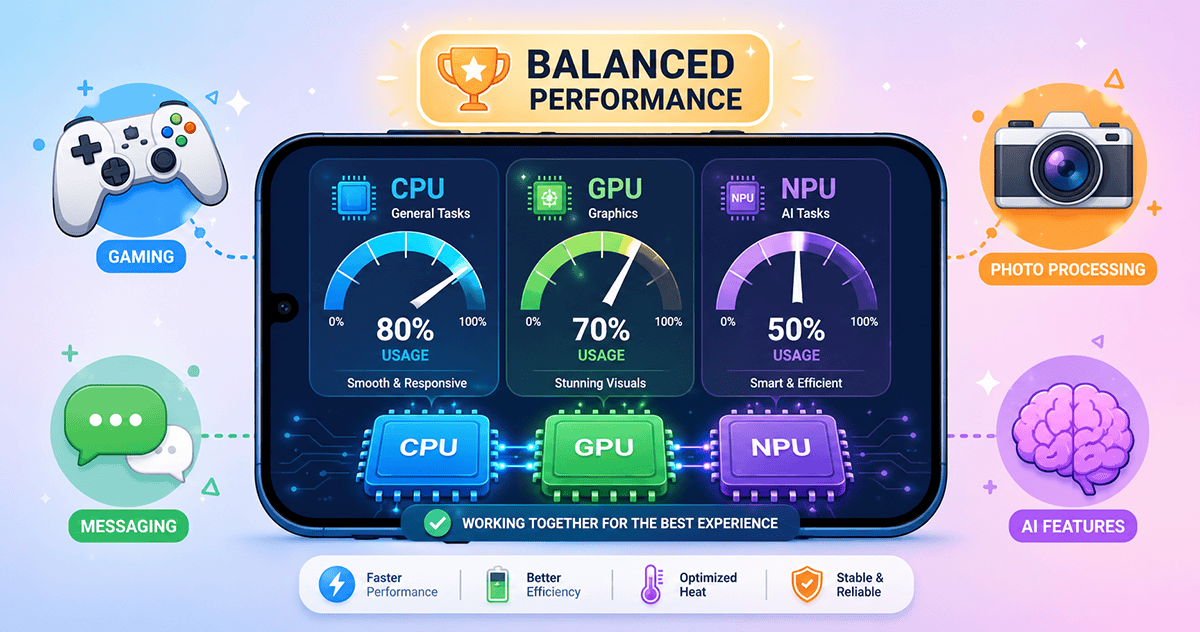
Modern phones don't rely on a single processor. They use "heterogeneous computing," where these three processors collaborate to perform tasks efficiently. The operating system distributes tasks to the most suitable processor:
- CPU manages everything and decides which processor will handle the task.
- GPU handles heavy graphics tasks to ensure a smooth gaming experience.
- NPU processes AI tasks in the background, saving battery power and keeping the device cool.
- CPU runs the camera app and receives the command to capture the photo.
- GPU renders the preview smoothly on the screen.
- NPU analyzes the image, separates the person from the background, and applies the bokeh effect quickly and with low power consumption.
🔮 6. The Future of Processors in Phones: The Power of AI
With the growing reliance on artificial intelligence in everyday apps, the NPU has become a critical component in 2026 phones. Manufacturers are racing to develop more powerful neural processors. In the near future, NPUs will become even more important for running large language models (LLMs) on-device, enabling more advanced AI features without relying on the internet or consuming excessive power.
✅ Conclusion: Which Processor Matters When Buying a New Phone?
- If you're a gamer: Pay attention to the GPU power—it's the foundation for gaming performance and graphics quality.
- If you're into photography and AI-powered apps: Look for a phone with a powerful NPU—you'll notice the difference in photo processing speed and smart features.
- If you're a daily user: CPU performance is the key to system smoothness and app responsiveness.
Ultimately, a balanced phone is one that combines powerful processors of all three types, working together to deliver the best possible experience. As technology advances, understanding these components becomes increasingly important for choosing the right phone for your needs.