Fast Charging Protocols Explained: PD, PPS, QC, UFCS, SCP – Features & Differences - Complete Guide
⚡ Fast Charging Protocols Explained: PD vs PPS vs QC vs UFCS vs SCP – Differences, Comparison & How to Choose the Right Charger
Have you ever wondered why your phone that supports 65W fast charging doesn't charge at the same speed with another 65W charger? The secret lies in "fast charging protocols" – the language your charger uses to communicate with your phone. In this comprehensive guide, we'll explain the most important fast charging protocols in 2026, their features, and the differences between them, to help you choose the right charger for your phone.
📖 1. What Are Fast Charging Protocols and Why Do They Matter?
A charging protocol is a "communication language" between the charger and the phone. When you connect your phone to a charger, both devices perform a "handshake" to identify which protocols they share. For example, the charger says "I can deliver PD 3.1 at 140W," and the phone replies "I need SCP at 66W." If they find a common protocol, charging proceeds at the highest power supported by that protocol. If not, they fall back to basic slow charging (typically 5V/2A or 18W).
Charging protocols fall into two main categories:
- Open (Universal) Protocols: Available to everyone and work across different devices and brands. The most notable are PD, PPS, QC, and UFCS.
- Proprietary (Closed) Protocols: Developed by manufacturers for their own phones only, and not licensed to others. The most notable are SCP (Huawei) and VOOC (OPPO).
🌐 2. Universal (Open) Protocols
🔹 USB Power Delivery (PD) – The Universal Language
Developer: USB-IF (USB Implementers Forum).
Key Features:
- Most widely adopted globally: Supported by iPhones (from iPhone 8 onward), MacBooks, Android flagship devices, and Nintendo Switch.
- High power capability: Supports up to 240W in PD 3.1, making it capable of charging laptops as well.
- Voltage flexibility: Supports multiple voltage levels (5V, 9V, 15V, 20V) and negotiates the optimal one.
- Bi-directional charging: A device can be either a power source or a sink (e.g., charging another phone from yours).
✅ Who benefits: All users, especially iPhone and MacBook users, as PD is the primary and officially supported protocol by Apple.
🔹 Programmable Power Supply (PPS) – Precise Voltage Control
Developer: A subset of USB PD 3.0.
Key Features:
- Voltage adjustment in tiny steps (20mV): Instead of jumping between 5V, 9V, and 15V, PPS can adjust voltage in precise 20mV increments.
- Smarter, cooler charging: By matching voltage to the battery's exact needs at any moment, PPS reduces heat generation inside the phone, protecting the battery and extending its lifespan.
- Essential for some phones: Samsung phones (from S21 to S26) and Google Pixel devices rely on PPS to achieve their advertised maximum charging speeds (e.g., 45W for Samsung).
✅ Who benefits: Samsung and Google Pixel users, and anyone who wants smarter, cooler charging for their phone.
🔹 Qualcomm Quick Charge (QC) – The Pioneer of Fast Charging
Developer: Qualcomm.
Key Features:
- One of the oldest fast charging protocols: Started with QC 1.0 in 2013 and has evolved to QC 5.0 supporting over 100W.
- Widespread in Android devices: All phones with Snapdragon processors support QC to some extent.
- Compatible with PD: Starting from QC 4.0, the protocol became compatible with USB PD and PPS, meaning a QC 5 charger can also charge PD devices.
✅ Who benefits: Users of Android phones with Snapdragon processors, especially older models that may not support PD efficiently.
🔹 UFCS (Universal Fast Charging Specification) – The Chinese Dream of Unification
Developer: China Communication Standards Association, in collaboration with Huawei, OPPO, vivo, and Xiaomi.
Key Features:
- A unified Chinese protocol: Aims to make chargers from different Chinese brands compatible with each other.
- Promising power: Supports up to 200W, delivering moderate charging speeds (40-80W) across different phones.
- Growing adoption: By 2026, over 279 UFCS-certified products have been released, though certified power banks remain limited (only 9 products).
✅ Who benefits: Users of Chinese phones (Huawei, Xiaomi, OPPO, vivo) who want a single charger that works across all their devices at decent speeds (40-80W), without needing a proprietary charger for each device.
🔒 3. Proprietary (Closed) Protocols
🔹 SCP (SuperCharge Protocol) – Huawei's Protocol
Developer: Huawei.
Key Features:
- Low voltage, high current: Operates at low voltage (e.g., 5V or 10V) with very high current (e.g., 6A), reducing heat inside the phone.
- High power: Supports up to 100W+ (66W and 100W are common).
- Completely closed: No third-party charger can activate full fast charging (66W+) without Huawei's license. Unlicensed chargers fall back to PD or FCP and are limited to 18-22.5W.
✅ Who benefits: Huawei and Honor users. For maximum speed, you must use an original or Huawei-certified charger.
🔹 VOOC / SuperVOOC – OPPO's Protocol
Developer: OPPO.
Key Features:
- Very high current, fixed voltage: Relies on extremely high current (up to 10A+) with fixed voltage (5V), minimizing heat.
- The most isolated: VOOC is the most tightly locked among proprietary protocols. No third-party charger can activate fast charging for OPPO; it's limited to 18W.
- Exceptional power: SuperVOOC supports up to 120W, with newer versions reaching 240W.
✅ Who benefits: OPPO, OnePlus, and Realme users. You must use the original charger and cable for maximum speed.
🔹 Other Proprietary Protocols
- Xiaomi HyperCharge (MiPPS): Xiaomi's proprietary protocol built on PPS with custom modifications. Supports up to 120W and is less strict than SCP and VOOC – some third-party chargers (especially from brands like CukTech) can trigger fast charging.
- vivo FlashCharge: vivo and iQOO's proprietary protocol, supporting up to 120W+, and is completely closed like VOOC.
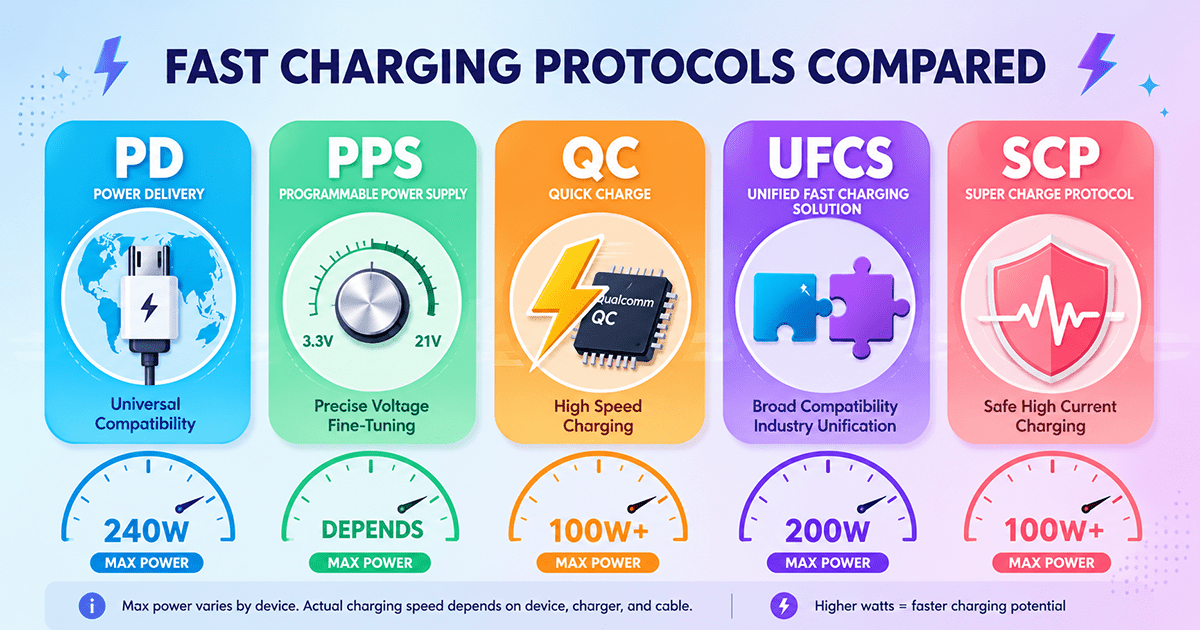
📊 4. Quick Comparison Table
| Protocol | Type | Max Power | Key Feature | Primary Users |
|---|---|---|---|---|
| PD | Open | 240W | Global standard, universal compatibility | iPhone, MacBook, Android |
| PPS | Open (PD subset) | Depends on PD | Precise voltage adjustment, lower heat | Samsung, Google Pixel |
| QC | Open | 100W+ | Widespread in Android | Snapdragon phones |
| UFCS | Open (Chinese) | 200W | Unifies Chinese brands | Huawei, Xiaomi, OPPO, vivo |
| SCP | Proprietary | 100W+ | Low voltage, high current, low heat | Huawei, Honor |
| VOOC | Proprietary | 240W | Very high current, ultra-cool charging | OPPO, OnePlus, Realme |
✅ 5. How to Choose the Right Charger for Your Phone? (Quick Guide 2026)
- If you use an iPhone or MacBook: Look for a charger that supports USB PD with at least 20W-30W. You don't need other protocols.
- If you use Samsung or Google Pixel: Make sure the charger supports PPS (within PD) for maximum speed (25W or 45W).
- If you use Huawei or Honor: For 66W charging, you must use an original or Huawei-certified SCP charger.
- If you use OPPO, OnePlus, or Realme: You must use an original VOOC or SuperVOOC charger. No third-party alternatives work effectively.
- If you use Xiaomi: You can use a PPS charger (with QC) for good speed, or the original HyperCharge charger for maximum speed.
- If you own phones from multiple Chinese brands: Look for a charger that supports UFCS to get decent speeds (40-80W) across all your devices.
In the end, remember that actual charging speed depends on protocol compatibility between the charger, the phone, and the cable. A good cable that supports high current (at least 5A) is essential to get the most out of any protocol.