LPDDR5 vs LPDDR5X vs LPDDR6: Speed, Power, and Gaming Performance Compared - Complete Guide
🧠 LPDDR5 vs LPDDR5X vs LPDDR6: What's the Difference? RAM Speed, Power Efficiency, Gaming Performance & Is the Upgrade Worth It?
When buying a new phone, we often focus on the RAM capacity—8GB, 12GB, or 16GB. But the "capacity" number doesn't tell the whole story. There's another equally important factor: the memory "generation"—LPDDR5, LPDDR5X, and now LPDDR6. In this guide, we'll explain the differences between these generations in terms of speed, power consumption, and real-world gaming and app performance, and answer the ultimate question: Will you actually feel the difference on your phone?
📚 1. What is LPDDR Memory and Why Does It Matter?
LPDDR stands for Low Power Double Data Rate, a type of RAM designed specifically for mobile devices like smartphones, tablets, and handheld gaming consoles. It features low power consumption, compact size, and high data transfer speeds, making it ideal for battery-powered devices. This memory works alongside your phone's processor to store and quickly retrieve frequently used data, ensuring smooth multitasking and app performance.
⚡ 2. LPDDR5: The Revolutionary Start (2019)
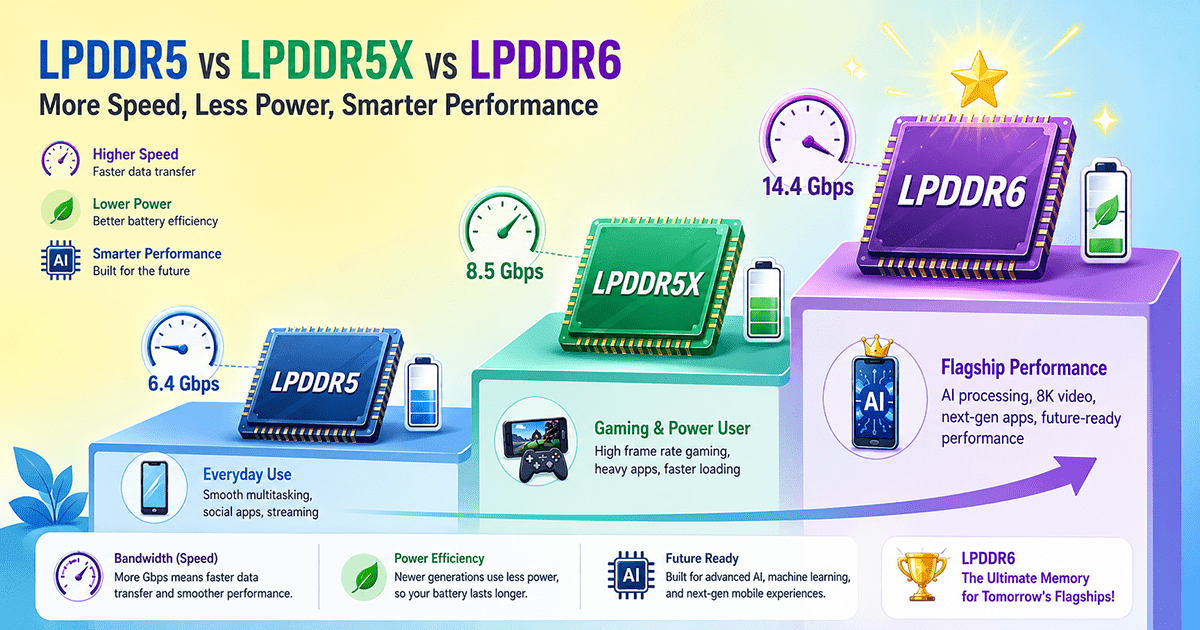
When the LPDDR5 standard was released in 2019, it was a massive leap in phone memory technology. Data transfer speeds doubled compared to the previous LPDDR4X generation, reaching 6.4 Gbps per pin. This meant faster app launches, better support for 5G technology, and a noticeable improvement in multitasking. LPDDR5 also introduced new features like Dynamic Voltage Scaling for improved power efficiency.
🚀 3. LPDDR5X: The Speed Demon (2021)
Just two years later, the LPDDR5X standard was released, pushing speeds to 8.533 Gbps with minor improvements over LPDDR5. But that wasn't the end—SK Hynix pushed speeds to 9.6 Gbps under the LPDDR5T name, and Samsung reached 10.7 Gbps on the Dimensity 9400 platform. LPDDR5X remains the dominant standard in most high-end smartphones today, representing the vast majority of LPDDR memory shipped.
🌟 4. LPDDR6: The Next Generation (2025-2026)
In July 2025, JEDEC officially released the LPDDR6 standard (JESD209-6), ushering in a new era of low-power memory. LPDDR6 combines several fundamental improvements that make it a true generational leap:
🔹 Data Transfer Speed
LPDDR6 starts at 10.667 Gbps and reaches up to 14.4 Gbps per the official specification—a 69% increase over LPDDR5X and more than double LPDDR5's original speed. SK Hynix has demonstrated 14.4 Gbps on a 16Gb chip using 1c-nm technology, while Samsung focused on power efficiency at 12.8 Gbps.
🔹 Bandwidth
With LPDDR6, bandwidth doubles significantly. Each chip delivers 38.4 GB/s compared to roughly 17 GB/s for LPDDR5X—making LPDDR6 2.25× faster than LPDDR5X and over 3× faster than LPDDR5.
🔹 Bus Width
LPDDR6 transitions from 16-bit channels to a 24-bit channel organized as two 12-bit sub-channels. In quad-channel phones, this increases bus width from 64-bit to 96-bit, significantly boosting data throughput between memory and processor.
🔹 Dual Sub-Channel Architecture
The two 12-bit sub-channels allow independent request processing, reducing latency and improving flexibility. Each sub-channel handles 32 bytes of data per burst (compared to 64 bytes in LPDDR5), enhancing efficiency for irregular data access patterns common in AI applications.
🔹 Burst Length
LPDDR6 extends burst length from 16 to 24. Each burst transfers 288 bits total—256 bits of user data and 32 bits of metadata for reliability and power-saving features.
🔹 Power Efficiency Improvements
LPDDR6 introduces a Dynamic Efficiency Mode that disables one sub-channel during low-bandwidth demand, significantly reducing power consumption. In power-saving mode, standby current drops to 87.3% and operating current to 81.1% of normal mode. Samsung reports a 21% overall power improvement compared to LPDDR5X, with read power reduced to 73% and write power to 78% of LPDDR5X.
🔹 Reliability and Security Enhancements
- On-Die ECC (Error Correction Code): Now mandatory in LPDDR6, unlike LPDDR5X where it was optional.
- PRAC (Per Row Activation Counting): Protects against Rowhammer attacks by tracking row activations.
- Programmable Link Protection: Enhances security for data transfers between memory and processor.
📊 5. Quick Comparison Table
| Feature | LPDDR5 | LPDDR5X | LPDDR6 |
|---|---|---|---|
| Max Speed | 6.4 Gbps | 8.533 - 10.7 Gbps | 14.4 Gbps |
| Max Bandwidth (per chip) | ~17 GB/s | ~17 GB/s | 38.4 GB/s |
| Channel Width | 16-bit | 16-bit | 24-bit (12+12) |
| Burst Length | 16 / 32 | 16 / 32 | 24 / 48 |
| ECC Support | Optional | Optional | On-Die (Mandatory) |
| Operating Voltage | 1.1V | 1.05V | 1.025 / 0.875V (dual-voltage) |
| Power Efficiency (vs LPDDR5X) | Reference | Reference | +20-30% improvement |
| Release Year | 2019 | 2021 | 2025 |
🎮 6. Will You Actually Feel the Difference? Real-World Performance
This is the key question. The numbers are impressive, but will you notice the difference in daily use? The answer depends on what you do with your phone:
🔹 In Heavy Gaming
Games like Genshin Impact, Call of Duty: Warzone Mobile, and PUBG Mobile demand high memory bandwidth. With LPDDR6, you'll notice faster level loading, reduced stuttering especially during fast-paced action, and more stable frame rates (FPS) during intense battles. The difference between LPDDR5 and LPDDR6 in these scenarios can be very significant, especially when running games at the highest graphics settings.
🔹 In Heavy Multitasking
If you're a heavy multitasker—running multiple apps, heavy web browsing, background video playback, and switching between apps quickly—LPDDR6 will significantly reduce app reload times when switching between them.
🔹 In AI and Imaging Apps
With the rise of on-device AI applications like image processing, video editing, and real-time translation, memory speed becomes a critical factor. LPDDR6's new dual sub-channel architecture significantly improves performance for these irregular, random memory-access workloads.
🔹 In Everyday Light Use
If you use your phone for social media, calls, messaging, and video watching, you're unlikely to notice a big difference between LPDDR5X and LPDDR6. Ultra-high speeds aren't required for these tasks. However, you might notice the difference when opening heavy apps or navigating the system UI after extended use.
✅ 7. Which Generation Should You Choose for Your Next Phone?
- If you're a pro gamer or power user: Look for a phone with LPDDR6 for the best future-proof performance. Flagship phones with next-gen processors (Snapdragon 8 Elite or Dimensity 9500) will support this memory.
- If you're a casual user or on a budget: LPDDR5X is still an excellent choice and will serve you efficiently for years. Most current high-end phones use it.
- If you're buying a used or mid-range phone: LPDDR5 is perfectly sufficient for all basic and moderate needs.