Dual SIM Explained: Physical Nano-SIM vs eSIM (Complete Guide)
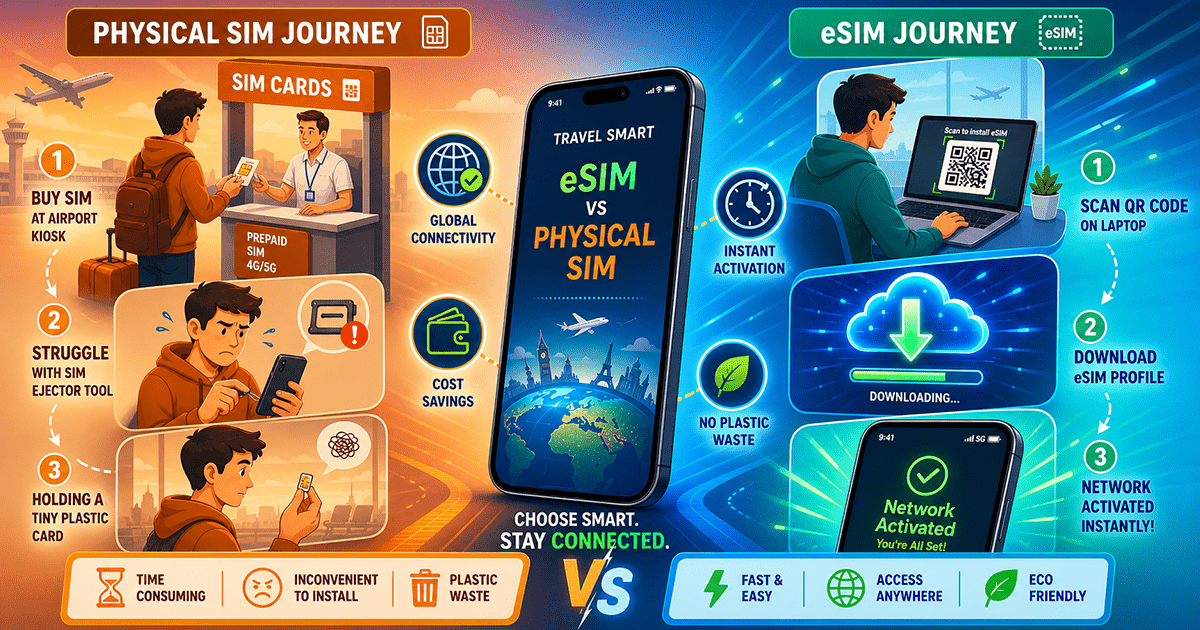
📱 Traditional SIM, Nano SIM, and eSIM: What are the key differences?
Do you need two numbers on one phone? One for work and one for family? Or do you travel frequently and want to avoid expensive roaming charges? Dual SIM technology is the answer. But today, you have two options: the traditional physical Nano-SIM or the embedded eSIM. In this guide, we'll compare both from every angle to help you choose the best option for 2026.
📖 1. What is Dual SIM Technology?
Simply put, Dual SIM is the ability of a phone to receive two SIM cards simultaneously in the same device. You can switch between them for calls, messages, and data. Two main types exist:
- Dual SIM Standby (DSS): Most common in modern phones. Uses one transceiver that switches between SIMs. When you make a call on one SIM, the other becomes inactive for incoming calls.
- Dual SIM Active (DSA): Uses two transceivers, allowing both SIMs to remain active simultaneously. Can receive calls on the second number while talking on the first. Rare in modern phones and consumes more power.
Most phones today support what's called Dual SIM Dual Standby (DSDS), regardless of whether the SIM is physical or electronic.
💳 2. What's the Difference Between Nano-SIM and eSIM?
🔹 Physical Nano-SIM
The small plastic card you insert into a dedicated slot. Contains a microprocessor and memory that identifies you to your carrier's network.
🔹 eSIM (Embedded SIM)
A non-removable chip soldered onto the phone's motherboard during manufacturing. Activated and changed over-the-air (programmatically) without needing to swap physical cards.
A phone can support one physical SIM + one eSIM (most common in flagships), two eSIMs (like some US iPhone models), or two physical SIMs (some mid-range phones).
⚖️ 3. Comprehensive Comparison: Nano-SIM vs eSIM
| Aspect | Nano-SIM (Physical) | eSIM |
|---|---|---|
| Form Factor | Separate plastic card inserted into tray | Chip embedded inside phone, non-removable |
| Activation Method | Insert physical card into device | Download profile over internet (QR code or app) |
| Ease of Switching Numbers | Requires removing SIM and replacing it | Easy and instant from settings menu, can store 8-20 profiles |
| Security | Vulnerable to cloning and SIM swap attacks | More secure, cannot be easily removed or cloned |
| For Travelers | Must buy and install local SIM each trip | Ideal for travel, buy local data pack online and activate instantly |
| Compatibility | Works on 100% of phones | Only modern phones (iPhone XS/XR+, latest Pixel, Galaxy) |
| Environmental Impact | Plastic waste | Eco-friendly |
⚡ 4. When to Choose Physical Nano-SIM?
- Your phone is old: Doesn't support eSIM.
- You want the simplest solution: Insert SIM and go; no apps or settings.
- Tight budget: Budget phones don't support eSIM yet.
- Long-term stay abroad: Local physical SIM may be cheaper than tourist eSIM plans.
🌐 5. When to Choose eSIM?
- Frequent traveler: Buy local data packs before departure and activate on arrival.
- Need two numbers flexibly: Add work or travel number instantly, switch with a tap.
- Want better security: Harder for thieves to steal your identity via eSIM.
- Use multiple devices: Smartwatches and modern iPads rely heavily on eSIM.
- Care about environment: eSIM reduces plastic waste.
⚠️ 6. Security: Which is Safer?
eSIM is more secure against physical attacks.
- SIM Swap attacks: Can happen with both. Depends on tricking customer service. Solution: don't rely solely on SMS for banking authentication.
- Physical risks: If phone stolen, thief can remove physical SIM and use in another phone. Transferring eSIM requires password or customer service verification.
✅ Final Verdict
In 2026, Dual SIM is no longer a luxury but a necessity for many. While physical Nano-SIM remains reliable and universally compatible, eSIM wins on flexibility, ease of use, and security – especially with growing carrier and phone support. If buying a new phone today, we strongly recommend choosing one that supports eSIM.