Do Megapixels Really Matter in Phone Cameras? Why 50MP Sometimes Beats 200MP - Complete Guide
📸 50MP vs 200MP Smartphone Camera: Megapixels, Photo Quality and Image Resolution Explained
When buying a new phone, a big number on the box immediately grabs your attention: "200 megapixels." It sounds impressive, and you automatically assume this phone will take better photos than another that "only" has 50 megapixels. But the truth is far more complex. In this guide, we'll debunk the megapixel myth, explain why a 50MP camera can outperform a 200MP one under certain conditions, and what specifications you should actually look at when choosing your next phone.
🧮 1. What Exactly Is a Megapixel? (The Basics)
The word "megapixel" literally means "one million pixels." A pixel is the smallest point of light in a digital image. So, a 50-megapixel camera captures images made of 50 million points, while a 200MP camera captures images of 200 million points. Theoretically, this means much more detail, especially when you zoom in or crop a small portion of the image. This advantage becomes practically clear when printing at very large sizes or when you need to enhance the quality of a cropped photo.
Think of megapixels as the number of buckets you use to collect rainwater. 200 buckets sounds better than 50, but if the buckets are very small, they might not collect enough water. Meanwhile, 50 large buckets will collect more water. This is where "sensor size" and "pixel size" come into play.
🏆 2. Why Does a 50MP Camera Sometimes Beat a 200MP One? (The Hidden Factors)
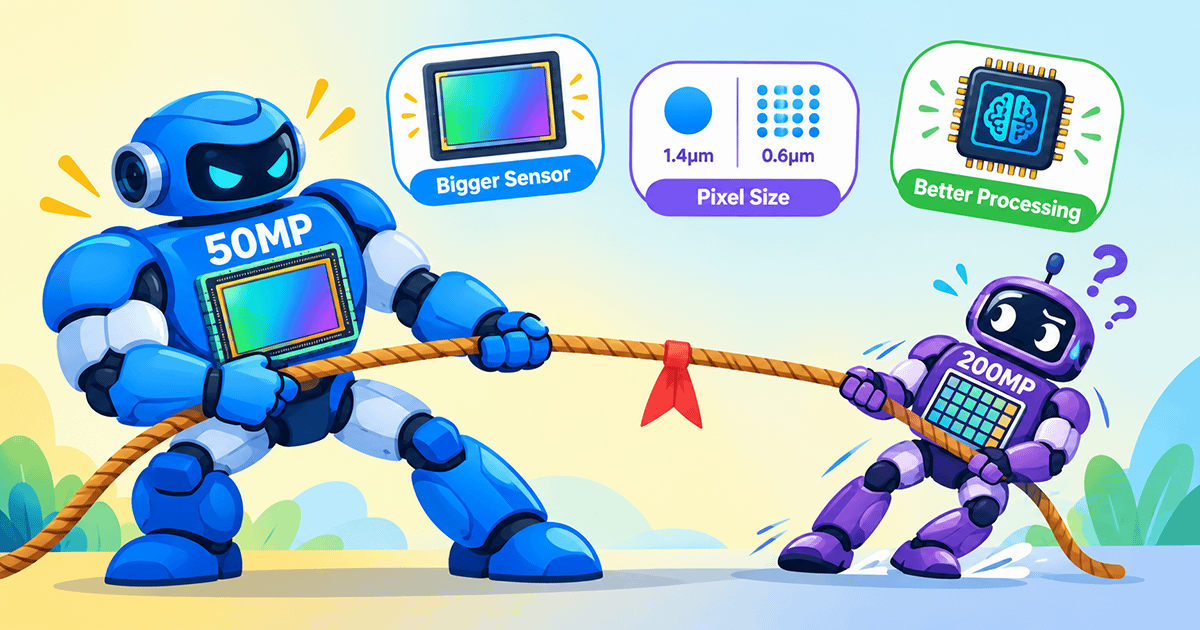
The answer lies in the fact that image quality is not a single number, but the result of a complex interaction between several components. Megapixels are just one factor—and often the least important one.
🔹 Sensor Size: The Real Deal
The camera sensor is the electronic chip that captures light and converts it into a digital signal. The golden rule: the larger the sensor, the better. A larger sensor captures more light, resulting in brighter images, more accurate colors, less noise, and much better performance in low light. Think of the difference between a small window and a large window in a room: the large window lets in far more light. A 50MP sensor in a flagship phone might be 1/1.3-inch in size, while a 200MP sensor in another phone might be smaller. The larger sensor always wins.
🔹 Pixel Size: Small Buckets vs. Large Buckets
When you pack 200 million pixels into a small sensor, each pixel becomes very small. A small pixel captures less light, leading to noisier images, especially at night. In contrast, a 50MP camera on a large sensor gives each pixel more area to capture light. This is exactly why a 50MP camera with a large sensor can outperform a 200MP camera with a smaller sensor, particularly in low-light conditions.
🔹 Pixel Binning: The Smart Trick
How do manufacturers solve this dilemma? With "pixel binning" technology. When shooting in low light, the camera combines several small pixels to work as one large virtual pixel. For example, a 200MP camera might combine 16 pixels into one, producing a final 12.5MP image. This gives it better light sensitivity and less noise. However, the real advantage of a 50MP camera is that it doesn't need as much processing and may naturally produce a better image. In daylight, a 200MP camera can use every pixel for enormous detail, but this requires excellent lighting and very powerful processing to avoid issues.
⚖️ 3. Head-to-Head: 50MP vs. 200MP
| Comparison Point | 50MP Camera | 200MP Camera |
|---|---|---|
| Detail (Daylight) | Excellent | Exceptional (more detail when zooming) |
| Low-Light Performance | Superior (less noise, better colors) | Variable (depends on sensor size and processing power) |
| File Size | Moderate (10–15 MB) | Huge (25–40 MB) |
| Processing Speed | Faster | Slower (longer wait between shots) |
| Practical Use | Ideal for all conditions | Ideal for large prints and extreme crops in good lighting |
🧠 4. Lessons from Real-World Tests
Extensive tests on 44 phones have measured each camera's accuracy under different lighting conditions. The results were revealing:
- Going from 8MP to 50MP: A real, noticeable upgrade, especially in detail and image sharpness.
- Going from 50MP to 200MP: Not as big an upgrade as some expect. The difference exists but is much smaller than the leap from 8MP to 50MP.
- The shocking truth: A good 50MP camera beats a mediocre 200MP camera in all lighting conditions. The gap between the best and worst phone in the same megapixel class can be wider than the gap between the 50MP and 200MP classes!
This means that brand, lens quality, processing, and software play a much bigger role than the megapixel count alone.
✅ 5. Conclusion: What to Look for When Buying a Phone
Don't let the megapixel number fool you. When evaluating a phone camera, look for these factors instead:
- Sensor size: Look for the "sensor type" (e.g., 1/1.3-inch). Smaller denominator numbers (with numerator 1) mean a larger sensor.
- Pixel size: Look for "pixel size" in micrometers (µm). Higher is better. 1.2µm is better than 0.7µm.
- Lens type: Is it wide? Ultra-wide? Telephoto? Each type has its use.
- Optical Image Stabilization (OIS): Essential for shake-free video and night shots.
- Processing and computational photography: This is the most important factor of all. Companies that invest in smart algorithms achieve far better results than those focusing only on numbers.
In the end, a phone camera is an integrated system. A 200MP number alone doesn't guarantee a great photo, just as a 50MP number doesn't mean a bad one. The best approach is to look for a phone with a good balance of sensor size, lens quality, and processing power. That way, you'll get great photos in any condition, not just in perfect lighting.