Fast Charging Specs Explained: Watts (W) and Safety Tech (Complete Guide)
⚡ What Is Fast Charging and How Does It Work? Difference Between Fast Chargers and Regular Chargers in Speed & Safety (2026 Guide)
Fast charging is no longer just a big number on the box. In 2026, fast charging technology has become more intelligent and sophisticated than ever. While companies boast numbers like 45W, 65W, and even 240W, the real question isn't "how many watts?" but "how is that power delivered safely?" In this guide, we'll explain everything you need to know about fast charging specifications—from what watts really mean to the hidden safety technologies that protect your battery health.
🔋 1. What are Watts (W) in Charging?
The watt is the unit of electrical power, representing the rate at which energy is transferred from the charger to your phone. It is calculated by multiplying voltage (V) by current (A): W = V × A. For example, a 20W charger (5V × 4A) will charge your phone faster than a 5W charger (5V × 1A). But a higher wattage number doesn't necessarily mean faster charging all the time, because modern phones use intelligent charging curves that change based on battery temperature and charge level.
📉 2. The Charging Curve: Why 0-100% Isn't Uniform Speed
The biggest misconception about fast charging is that a phone charges at its full wattage from 0% to 100%. In reality, charging happens in three distinct stages, each designed to protect your battery:
- Stage 1 (0-50%): "The Bulk Sprint" – When your battery is low, its internal resistance is low, allowing it to absorb higher wattage (peaking at ~27-29W for iPhone Pro models) with minimal stress. This is where you get maximum speed.
- Stage 2 (50-80%): "The Saturation Taper" – As the cells fill up, the charger intelligently reduces wattage to prevent "over-stuffing" that generates excessive heat.
- Stage 3 (80-100%): "The Trickle Finish" – Once you hit 80%, the charger drops to a low-voltage trickle. This is crucial for long-term battery health, as keeping a battery under high voltage for extended periods accelerates chemical degradation.
🧠 3. PPS (Programmable Power Supply): The Intelligent Brains of Smart Charging
PPS is a revolutionary technology that allows a charger to adjust its voltage in tiny increments (as small as 20mV) in real-time, rather than using fixed voltages (like 5V or 9V).
- Why does this matter? When the charger matches the phone's exact voltage requirement, the power conversion happens inside the charger (not inside the phone). This means less heat inside your device, and therefore longer battery lifespan.
- Real-world example: Without PPS, a phone might have to "step down" 9V to 8V internally, generating heat. With PPS, the phone requests 8V directly from the charger, and it passes through efficiently.
🟢 4. GaN (Gallium Nitride): The Revolution in Charger Size and Efficiency
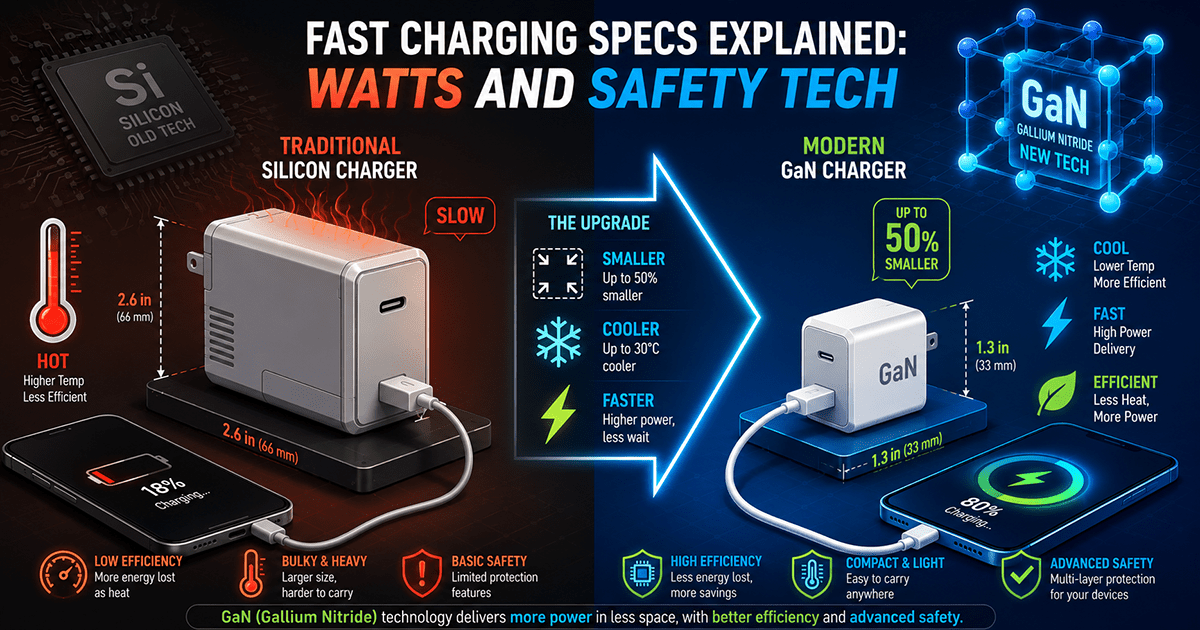
GaN is a modern semiconductor material that has replaced traditional silicon in next-generation chargers. Its benefits are substantial:
- Higher efficiency, less heat: GaN chargers lose less energy as heat compared to silicon, meaning more power reaches your phone.
- Smaller size: A 65W GaN charger can be as small as an 18W silicon charger. Perfect for travel.
- Proactive cooling: Some advanced chargers (like Anker Nano) perform millions of temperature checks daily (ActiveShield) to stay up to 36°F cooler than international safety standards.
🛡️ 5. Safety Technologies: How Smart Chargers Protect Your Battery
Heat is the number one enemy of lithium-ion batteries. The hotter the battery gets during charging, the faster its chemical degradation accelerates. Here's how modern technologies fight this problem:
🔹 Active Thermal Management Systems
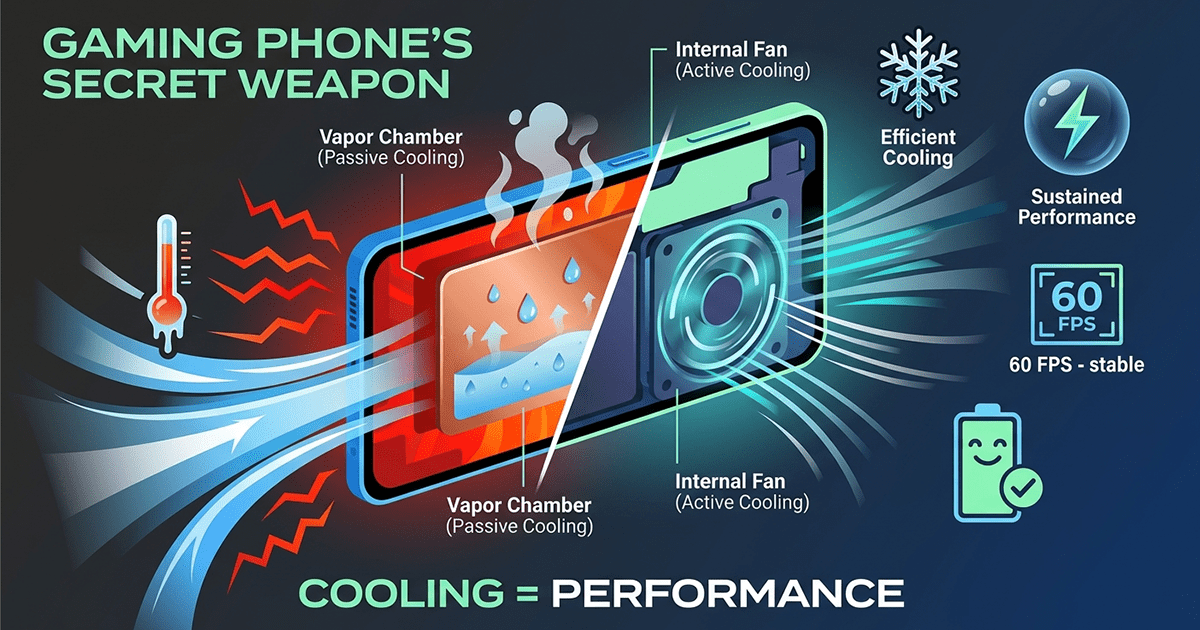
Today's chargers are equipped with thermal sensors that constantly monitor temperature. If it exceeds a safe limit (typically 35-40°C during fast charging), the charger automatically reduces power or switches to a "Care Mode" that lowers charging temperature.
🔹 Overcurrent and Overvoltage Protection (OCP & OVP)
Certified chargers comply with strict standards like USB PD 3.1 (supporting up to 240W) and IEC 62368-1. These standards ensure protection circuits exist that prevent unsafe voltage or current from reaching your phone.
🔹 Overcurrent Protection (OCP)
OCP circuits monitor the current flowing to the battery instantaneously. If the current exceeds safe limits (which may vary based on battery temperature and charge state), the circuit disconnects power in milliseconds. This protection is especially critical for ultra-fast charging (above 65W).
🔹 Short Circuit Protection (SCP)
Modern GaN chargers are designed to detect a short circuit in the cable or phone port within less than 1 millisecond. Once detected, they cut off power completely before any damage can occur.
🔹 Adaptive/Intelligent Charging (Night Mode)
Modern phones (like iPhones and Pixels) learn your sleep schedule. If you leave your phone on the charger overnight, it will fast charge to 80%, then stop. About an hour before you wake up, it resumes charging to reach 100%. This prevents the battery from staying under high voltage for hours, significantly extending its lifespan.
📊 6. Comparison of Common Charging Types in 2026
| Type | Power (W) | Time (0-50%) | Key Technologies | Expected Heat |
|---|---|---|---|---|
| Standard Charging | 5W - 12W | 90-120 min | Basic USB | 🟢 Very Low |
| Fast Charging | 18W - 25W | 30-45 min | QC, USB-PD | 🟡 Moderate |
| Ultra-Fast Charging | 45W - 65W | 15-20 min | PPS, GaN | 🟠 Managed high |
| Super-Fast Charging | 100W - 240W | 8-12 min | PPS + GaN + Liquid Cooling | 🔴 Requires active cooling |
🔌 7. USB Power Delivery (USB-PD): The Universal Standard
In the past, every manufacturer had its own proprietary charging protocol (OnePlus Dash Charge, Oppo SuperVOOC, Qualcomm Quick Charge). Today, the USB Power Delivery (USB-PD) standard has become the universal charging language supported by Apple, Google, Samsung, and many others.
- USB-PD 3.1: The latest version supports up to 240W, enough to fully charge laptops.
- Backward compatibility: One USB-PD charger can charge your phone, laptop, earbuds, and watch with the same cable.
- PPS is part of USB-PD: Most modern USB-PD chargers support PPS, giving you all the smart charging benefits mentioned above.
⚠️ 8. Common Fast Charging Myths You Should Stop Believing
- Myth: "Fast charging definitely destroys your battery." Truth: Well-designed modern fast charging (with PPS and good cooling) causes less damage than old slow charging because it reduces the time your battery spends under high voltage and excess heat.
- Myth: "You should drain your battery to 0% before charging." Truth: Lithium-ion batteries prefer charging from 20% to 80%. Deep discharge damages them more than frequent charging.
- Myth: "Leaving your phone on the charger overnight kills the battery." Truth: Modern phones automatically stop charging at 100%. However, using Adaptive/Intelligent Charging is better for overnight sessions.
- Myth: "You must use only the original phone charger." Truth: You can use any certified charger from a trusted brand that supports USB-PD, but avoid cheap, uncertified chargers.
✅ Conclusion: How to Choose the Right Charger for Your Needs
In the 2026 world, the question is no longer "how many watts?" but "what technologies do those watts support?" Look for a GaN charger that supports USB-PD and PPS with an active thermal management system. If you charge your phone overnight, enable the "Optimized Charging" or "Adaptive Charging" feature in your battery settings. Remember that fast charging is a great tool for daily use, but long-term battery health depends on moderate temperatures, avoiding deep discharge, and using certified chargers. By following these guidelines, you can enjoy ultra-fast charging while keeping your battery healthy for more than 3 years.