HDR Explained: HDR10+ vs Dolby Vision vs HDR Vivid on Phones - Complete Guide
🎨 What Is HDR10 on a Smartphone Display vs HDR10+ vs Dolby Vision? Are They Important and Which Delivers the Best Picture Quality?
When buying a new phone today, you'll find acronyms like HDR10+ and Dolby Vision on the spec sheet. Are these just marketing buzzwords, or do they make a real difference in picture quality? In this comprehensive guide, we'll explain everything you need to know about HDR standards on smartphones and compare the leading formats to help you choose your next device.
📖 1. What is HDR on Phone Screens?
HDR stands for High Dynamic Range, a technology designed to dramatically improve image quality compared to the older SDR (Standard Dynamic Range) standard.
Simply put, HDR allows a screen to display a wider range of colors and greater contrast between dark and bright areas of an image. This means blue skies will look more realistic, shadows will retain detail instead of becoming black blobs, and bright highlights (like sunlight glinting off water) will be brighter without "washing out" the rest of the image.
HDR is about two main things: peak brightness (luminance) and color depth (bit depth). An SDR screen typically supports up to 8-bit color (16.7 million colors), while HDR pushes that to at least 10-bit, which equals over 1 billion colors. HDR screens are also built to display a higher level of brightness than regular screens, creating a larger gap between the darkest blacks and the brightest whites.
🔬 2. The Baseline Standard: HDR10
Before we discuss advanced standards, let's understand HDR10. This is the basic, most widely adopted standard available on virtually all modern HDR displays.
HDR10 is characterized by:
- 10-bit color depth: Can display approximately 1.07 billion colors.
- Static Metadata: Uses a single set of brightness and color settings for the entire piece of content. This means a movie uses the same settings for both dark and bright scenes, which can reduce quality in some scenes.
- Open Standard: Royalty-free for any manufacturer to use, which explains its widespread adoption.
HDR10 is the starting point, but it's not the best. This is where advanced standards come in.
🚀 3. Advanced Standards: HDR10+, Dolby Vision, and HDR Vivid
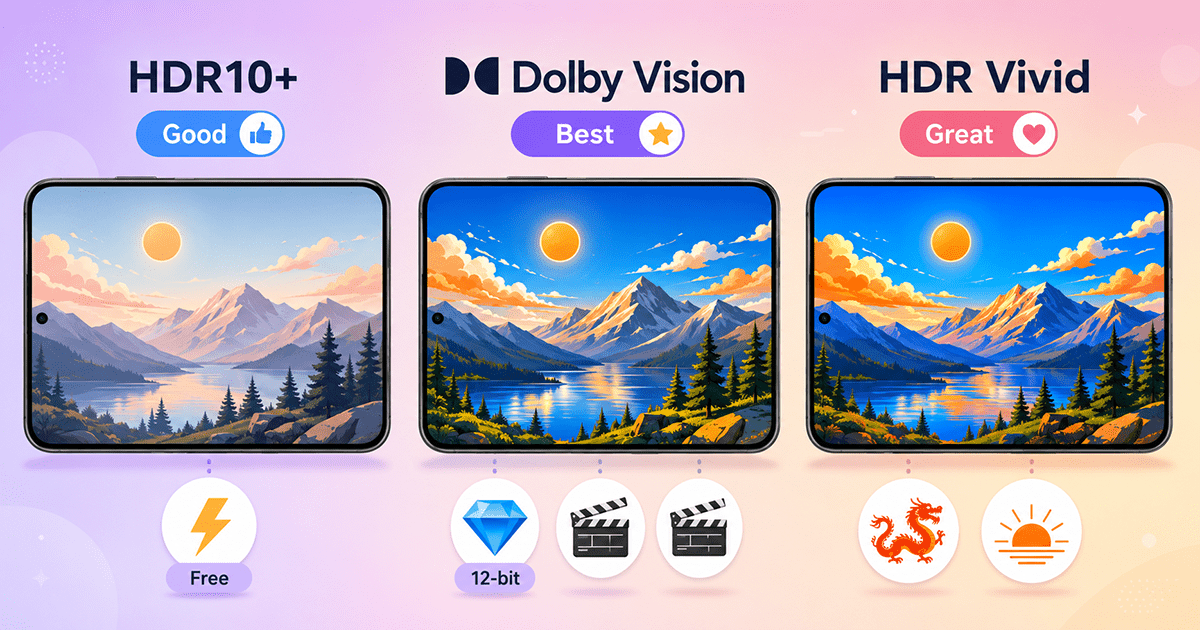
These three standards are evolutions of HDR10, and they all share a key feature: Dynamic Metadata. Instead of static settings for the entire piece of content, dynamic metadata allows brightness and color settings to be adjusted on a scene-by-scene or even frame-by-frame basis. This ensures every scene looks its absolute best.
🔹 HDR10+ – Samsung's Open Standard
Developed by Samsung in partnership with Panasonic and 20th Century Fox as a free, open alternative to Dolby Vision.
- 10-bit color depth: 1.07 billion colors (same as HDR10).
- Dynamic Metadata: Improves contrast and color per scene.
- Royalty-free open standard: Encouraged widespread adoption, especially from Samsung, which does not support Dolby Vision on its devices.
- Content Availability: Available on platforms like Amazon Prime Video, YouTube, and Google Play Movies, with over 2.8 million pieces of HDR10+ certified content across 16 streaming partners.
- Peak Brightness: Supports up to 4,000 nits theoretically.
If you're a Samsung user or spend a lot of time on Prime Video, you'll directly benefit from this standard.
🔹 Dolby Vision – Dolby's Reference Standard
This is the most advanced and highest-quality HDR standard, developed by Dolby Laboratories.
- 12-bit color depth: Can display up to 68.7 billion colors – 64 times more than HDR10. This provides incredibly smooth color gradients and eliminates color banding.
- Dynamic Metadata: The most refined and accurate implementation.
- Proprietary, Fee-based: Manufacturers pay licensing fees, which is why Samsung avoids it.
- Content Availability: Very widespread, especially on platforms like Netflix, Disney+, Apple TV+, and Max. It's also the standard used by iPhones for video capture.
- Peak Brightness: Supports up to 10,000 nits theoretically.
🔹 HDR Vivid – The Ambitious Chinese Standard
HDR Vivid is a domestic Chinese HDR standard aiming to compete with global standards.
- Supported by the Chinese government: Has become a national standard for broadcasting and media in China.
- Advanced Technology: Supports up to 10,000 nits brightness and 12-bit color depth, with frame-by-frame dynamic metadata.
- Growing Ecosystem: Supported by major Chinese companies like Huawei and Xiaomi, and available on platforms like Tencent (WeTV) and iQiyi.
- Global Ambitions: Has been accepted as part of a study in the International Telecommunication Union (ITU), potentially paving the way for global adoption.
HDR Vivid is a new player but strongly backed, making it an important option for users in the Chinese market.
📊 4. Comprehensive Comparison Table
| Feature | HDR10 | HDR10+ | Dolby Vision | HDR Vivid |
|---|---|---|---|---|
| Metadata | Static | Dynamic | Dynamic | Dynamic |
| Color Depth | 10-bit (1.07 billion colors) | 10-bit (1.07 billion colors) | 12-bit (68.7 billion colors) | 12-bit (68.7 billion colors) |
| Peak Brightness (Theoretical) | 1,000 – 4,000 nits | 4,000 nits | 10,000 nits | 10,000 nits |
| Licensing | Open (Free) | Open (Free) | Proprietary (Paid) | Chinese-developed |
| Major Supporters | All devices | Samsung, Google, Amazon | Apple, LG, Sony, Netflix, Disney+ | Huawei, Xiaomi, Tencent |
🔮 5. What's Next? Dolby Vision 2, HDR10+ Advanced, and Eclipsa Video
In 2025 and 2026, the next generation of HDR formats has begun to emerge, pushing the boundaries even further.
🔹 Dolby Vision 2
Announced in late 2025, Dolby Vision 2 is designed to support TVs reaching up to 10,000 nits of brightness. It introduces new features like "Authentic Motion," which allows creators to control motion smoothing on a shot-by-shot basis. However, content availability is currently extremely limited, with almost no movies or shows mastered in the format yet.
🔹 HDR10+ Advanced
Samsung's response, HDR10+ Advanced, optimizes for TVs reaching 5,000 nits and introduces AI-based algorithms to dynamically control motion performance. It also claims to improve cloud-based gaming performance by reducing latency. Like Dolby Vision 2, content is very scarce at this point.
🔹 Eclipsa Video (SMPTE ST 2094-50)
In a major development, Apple, Google, and NBCUniversal jointly developed an open-source HDR standard called Eclipsa Video. Unlike Dolby Vision 2 and HDR10+ Advanced which focus on TVs, Eclipsa Video's initial deployment targets mobile devices and computing platforms. It introduces new dynamic metadata technologies including "Reference White Anchor" (to allow SDR and HDR content to coexist on screen) and "Headroom-Adaptive Gain Curves" (to preserve highlight details on devices with limited brightness capabilities). The HDR10+ Alliance will manage this standard, with first certified products expected in late 2026. This could significantly change the HDR landscape on smartphones.
✅ 6. How to Choose Your Phone Based on HDR Support
- If you watch a lot of Netflix and Disney+: Dolby Vision is your best choice, as it's the dominant standard on these platforms. You'll need a phone from Apple, Huawei, OnePlus, or Xiaomi (flagship models).
- If you're a Samsung user or watch a lot on Prime Video: HDR10+ will be your optimal choice, well-supported on Samsung phones and Prime Video.
- If you're in the Chinese market or use Huawei devices: HDR Vivid is an important standard to ensure compatibility.
- General Advice: The best phones are those that support both HDR10+ and Dolby Vision. This gives you maximum compatibility with all types of content. This is the case for many flagship phones from Xiaomi, Vivo, and OnePlus.
Don't let marketing numbers fool you. A high-quality phone screen with high brightness (over 1000 nits) and wide DCI-P3 color gamut coverage is what matters most. The HDR standard comes next to enhance the experience. Enjoy your favorite content in the best possible quality!