Smartphone Battery Guide: mAh Capacity vs Real-World Performance
🔋 Smartphone Battery Guide: mAh Capacity vs Real-World Performance
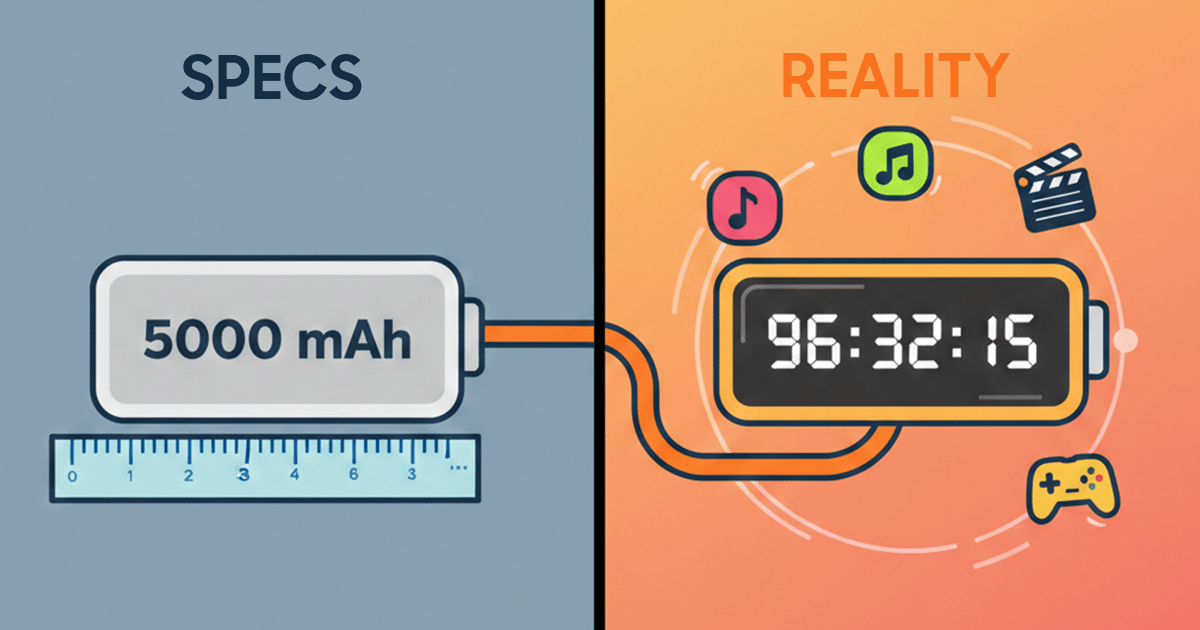
Have you ever bought a phone with a 5000mAh battery only to find it dies before the day ends? Meanwhile, your friend's phone with 4000mAh lasts two days? You're not alone. It's time to uncover the truth.
When buying a new phone, we often look at the big battery number: 4000mAh, 5000mAh, or even 6000mAh. But does this number reflect actual real-world performance? The short answer: not always. In this guide, we'll decode battery specifications and explain why a 2700mAh battery can sometimes outperform a 5500mAh one.
⚡ 1. What is mAh Exactly? (And Why It's Not Enough Alone)
mAh or milliampere-hour measures the electrical charge capacity a battery can store. Think of it as your car's fuel tank size. A larger tank (higher mAh) theoretically means you can drive longer, but this completely depends on fuel consumption (engine efficiency).
The problem is that mAh tells you about "charge" but not about the actual energy the battery can deliver, because it ignores a critical factor: voltage.
🔌 2. What is Watt-hour (Wh) and Why It's the Real Standard?
If mAh is the "tank size," Wh (Watt-hour) is the actual amount of fuel filling that tank with fuel pressure (voltage). It's the true measure of energy a battery holds.
This simple equation changes everything. Let's look at a real-world example:
📱 OnePlus 15 vs OnePlus 15R Test:
- OnePlus 15: 7,300mAh battery with efficient Snapdragon 8 Elite Gen 5 → 30:58 hours video playback
- OnePlus 15R: 7,400mAh battery with less efficient processor → 28:36 hours video playback
✅ Result: The phone with smaller capacity (7,300mAh) lasted 2.5 hours longer than the one with larger capacity (7,400mAh)!
This is why tech experts recommend looking for Wh rather than just mAh, especially when comparing different devices or battery types.
📉 3. Why Your 5000mAh Battery Dies Quickly (Hidden Factors)
Even after calculating Wh, other factors affect real performance. Imagine having a huge fuel tank (high Wh), but an inefficient engine (phone processor) that guzzles fuel. Result: short runtime.
🔹 Processor & Software Efficiency
Newer Snapdragon or Apple A-series chips are often more power-efficient. The same battery capacity on two different phones can perform completely differently due to system optimization. Recent tests show iPhone 17 Pro Max with only 5,088mAh outperforming many Android phones with larger batteries thanks to the A19 Pro chip and iOS 26 power management.
🔹 The Screen: Biggest Power Drain
High-resolution OLED screens with 120Hz refresh rates consume enormous power. Gaming at max brightness can consume ~800mAh per hour, while video streaming uses ~300mAh.
🔹 Battery Capacity Release Rate
Modern silicon-carbon batteries often suffer from a hidden issue: the battery capacity release rate. Many phones still use the old 3.0V cutoff voltage designed for graphite batteries, meaning silicon-carbon batteries can't fully release their stored energy.
| Usage Type | Approx. Consumption (from 5000mAh battery) |
|---|---|
| Heavy Gaming (120Hz, 5G) | 🔴 ~800mA/hour → about 6 hours |
| Video Streaming (Wi-Fi) | 🟡 ~300mA/hour → about 16 hours |
| Standby Mode | 🟢 ~20mA/hour → days |
🚀 4. The Silicon-Carbon Battery Revolution
In 2024-2026, we're witnessing a revolution with silicon-carbon battery technology. Unlike traditional graphite batteries, silicon offers 10x higher lithium-ion absorption capacity (theoretically up to 4200mAh/g vs graphite's 370mAh/g).
However, these batteries come with challenges. Most phones still use the old 3.0V cutoff voltage designed for graphite batteries, preventing silicon-carbon batteries from releasing their full capacity. This is why a 9000mAh phone might feel like only 7000mAh in real use.
🔄 5. Can You Replace a 4000mAh Battery with a 5000mAh One?
The answer: Yes, but only if the voltage is identical and physical dimensions fit. If voltage differs, the phone may malfunction or the battery may swell. The Battery Management System (BMS) in your phone is designed for specific voltage ranges.
✅ 6. How to Choose a Phone Based on Battery (Practical Guide)
🔍 Look at Wh First
Check reviews or specifications for Watt-hours (Wh). This is the most accurate number for comparing energy capacity across different phones.
📊 Don't Compare mAh Across Different OS
Comparing 5000mAh on Android with 4000mAh on iPhone is meaningless due to voltage differences and system efficiency.
📈 Check Real-World Battery Tests
Read actual battery tests (like web browsing or video playback tests). These reflect reality better than any theoretical number.
⚡ Consider Charging Speed
A 5000mAh battery with slow charging (15W) might be less useful than a 4500mAh battery with fast charging (65W) if you're a busy person.
💎 Golden Rule: Ask yourself: "How many hours of browsing or video do I need?" instead of "How many mAh do I need?" Marketing numbers deceive, but real-world tests don't lie.
📊 7. Real Test Results: What the Numbers Show
Recent comprehensive testing by CNET of 35 smartphones (2025-2026 models) revealed surprising results:
| Phone Model | Battery Capacity | Overall Rank |
|---|---|---|
| iPhone 17 Pro Max | 5,088 mAh | 🥇 #1 |
| iPhone 17 | 3,692 mAh | 🥈 #2 (tie) |
| OnePlus 15 | 7,300 mAh | 🥈 #2 (tie) |
| Poco F7 Ultra | 5,600 mAh | 🥉 #3 |
The iPhone 17, with the smallest battery in the top tier, matched phones with double its capacity.
❓ 8. Frequently Asked Questions
Q: Is 4000mAh good in 2026?
A: For average users, yes. But if you're a heavy gamer, you might want 5000mAh+ with fast charging. Processor efficiency matters most.
Q: Why does my 5000mAh phone die faster than my friend's 4500mAh phone?
A: Likely due to: (1) larger/higher resolution screen, (2) less efficient processor, (3) background apps, (4) weak network signal.
Q: What's the difference between mAh and Ah?
A: Ah (Ampere-hour) is 1000 mAh. Ah is often used for larger batteries like car batteries.
Q: Can a 2700mAh battery be stronger than 5500mAh?
A: Yes, if the first is in a laptop at 11V (producing 29.7Wh) and the second in a phone at 3.7V (producing 20.35Wh)! The laptop holds more energy despite the smaller mAh number.
Remember: A good battery is one that fits your usage, not the one with the biggest number in ads. Use this guide to be a smart consumer and choose your next phone based on real performance, not deceptive numbers. 💪🔋