Smartphone Camera Specs Explained: PDAF, OIS, AF, 17mm, 1/1.4", 0.6µm (Complete Guide)
📷 What Do PDAF, OIS, AF, Sensor Size, Pixel Size, and Lens Mean? A Complete Guide to Smartphone Camera Specs
When buying a new phone, you encounter a long list of strange camera terms: PDAF, OIS, AF, and numbers like 17mm or 1/1.4". Most of us ignore them or don't understand them, but these terms determine the difference between a great photo and a blurry one. In this guide, we'll decode every term in simple language, making you a camera expert in minutes.
🔍 1. Auto Focus (AF) – Why Are Your Photos Blurry?
AF stands for Auto Focus, the system that tells the camera lens how far to move to get a clear image. There are three main types:
🔹 Contrast Detection AF – The Slow Search Method
This system works like someone searching for their glasses: it moves the lens back and forth until it finds the highest contrast between pixels. An old method found in budget phones — accurate but slow, causing "focus hunting" especially in low light.
🔹 Phase Detection AF (PDAF) – Ultimate Speed
PDAF is today's gold standard. It uses dedicated pixels on the sensor surface acting like two "eyes" measuring distance, so the system knows exactly where to place the lens without trial and error. Result: instant focus, perfect for photographing fast-moving children and pets.
🔹 Laser AF – Dark Wizard
This is an "active" system that sends invisible laser beams to measure distance. It's super fast and works in complete darkness because it doesn't rely on ambient light. But its drawback: short range (usually under 5 meters) and it can get confused by reflective surfaces or glass.
🔹 Dual Pixel AF – Apple & Samsung's Tech
An evolution of PDAF where every pixel on the sensor is split into a pair (left and right), meaning 100% of pixels participate in focusing, not just some. This is the fastest and most accurate system available, found in advanced iPhones (Focus Pixels) and Samsung phones (Dual Pixel Pro).
🤚 2. OIS / EIS – The Difference Between Mechanical and Software Stabilization
Image stabilization is the savior from shaky photos and blurry night shots.
🔹 Optical Image Stabilization (OIS) – The Mechanical Solution
OIS is a physical system: your phone's gyroscope detects hand shake, and tiny motors move to compensate by shifting the lens or sensor in the opposite direction. Advantage: stabilization happens before light hits the sensor, so no quality loss. Ideal for night photography because it allows slower shutter speeds without shake.
🔹 Electronic Image Stabilization (EIS) – The Software Solution
EIS is digital processing after the photo or video is taken. The system crops parts of the frame and compensates for shake digitally. Disadvantage: you lose part of the image (crop) and quality may decrease. But it's excellent for video.
Today's flagship phones (like Google Pixel and iPhone) use a combination of OIS and EIS for the best results, especially in ultra-smooth video recording.
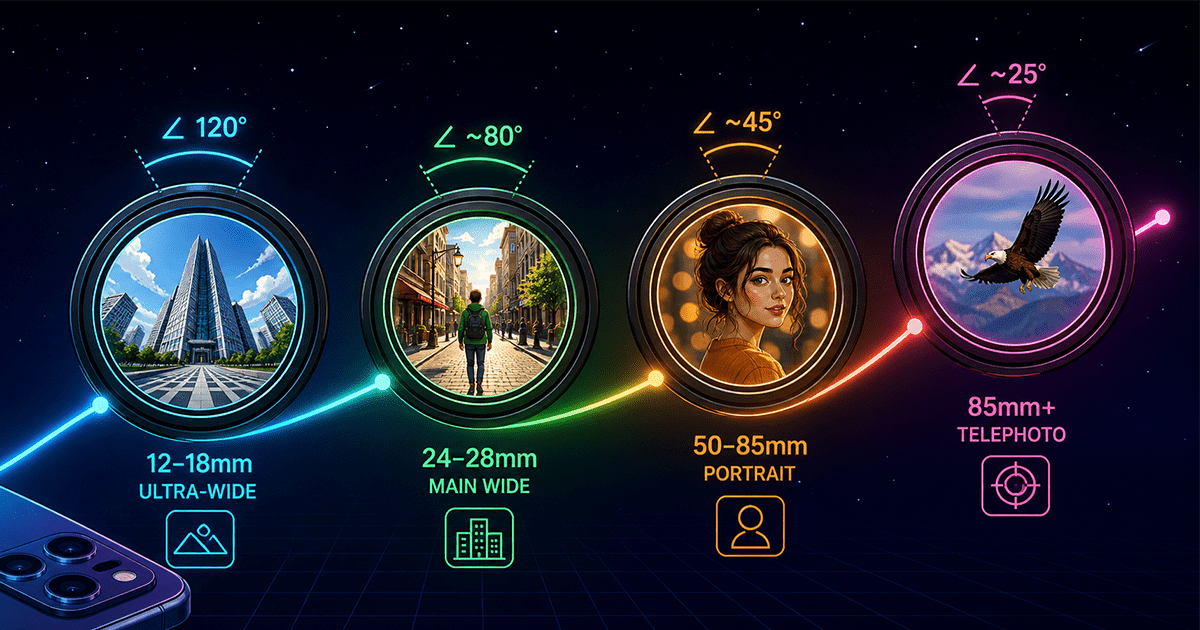
📏 3. The Numbers "17mm" and "24mm" – What Does the Compass Mean?
These numbers represent the focal length of the lens and determine the angle of view:
- 12mm – 18mm (Ultra-Wide): Captures a very wide angle (over 110 degrees). Perfect for landscapes and massive buildings, but distorts nearby objects.
- 24mm – 28mm (Wide – Main Camera): The gold standard for primary cameras on most phones. Balances image quality with a human-eye-like angle of view.
- 50mm – 85mm (Portrait / Telephoto): Good for portrait photos because it offers decent zoom and beautiful background blur (bokeh).
- 85mm+ (Telephoto): Used for optical zoom (3x, 5x or more), ideal for photographing birds or sports events from a distance.
📸 4. Sensor Size "1/1.4" and "1/2.76"" – The Hidden Trick Manufacturers Use
This term is the most important for night photography and image quality. The sensor is the camera's digital "film" that captures light.
Golden rule: The smaller the "fraction" number (i.e., the larger the denominator), the larger the sensor and the better. For example, 1/1.4" is much larger than 1/2.76".
But there's a historical trick! The "1/n inch" measurement system dates back to the 1950s and television tubes. The number does not represent the actual diagonal of the sensor. For example, a 1-inch sensor actually has a diagonal of about 16mm, not 25.4mm. The bottom line: 1/1.4" has roughly twice the area of 1/2.76", meaning it captures twice the light, resulting in clearer, less noisy night photos.
| Sensor Size | Approx. Diagonal | Approx. Area | Usage |
|---|---|---|---|
| 1″ (Type 1.0) | ~16 mm | ~125 mm² | Advanced camera phones (e.g., certain Sony Xperia series) |
| 1/1.4″ | ~11.5 mm | ~63 mm² | Flagship phones (e.g., Sony LYT808 in OnePlus 11) |
| 1/2.76″ | ~6.5 mm | ~20.6 mm² | Mid-range phones and ultra-wide cameras |
🔬 5. Pixel Size "0.6µm" and "1.2µm" – Details You Barely See
A pixel is a tiny "square" on the sensor. The larger the pixel size (measured in micrometers µm), the more light it can capture, resulting in clearer, less noisy images in low light. Example: a 1.2µm pixel collects four times more light than a 0.6µm pixel.
🔚 6. Quick Summary: Your Buying Guide
- For night photography and cafes: Look for OIS + large sensor (1/1.4" or bigger) + large pixels (>0.8µm actual).
- For kids and fast action: Ensure PDAF or Dual Pixel AF is present (all mid-range phones and above). Laser AF systems are great for close range.
- For landscapes and travel: An ultra-wide lens (under 18mm) is very useful.
Knowing these terms transforms you from a casual user into a professional buyer. The next time you read a phone spec sheet, you won't fear the strange symbols ever again.