CPU Manufacturing Nodes Explained: 4nm vs 3nm vs 2nm – Do They Affect Performance, Battery & Gaming? - Complete Guide
🔬 What Does 3nm, 2nm, and 1nm Mean in Smartphone Processors? How Nanometer Technology Affects Gaming Performance, Speed & Power Efficiency
When buying a new phone, you often see numbers like "4nm processor" or "3nm" and even "2nm" on the spec sheet. What do these numbers actually mean? Does a 3nm phone run twice as fast as a 4nm phone? Do they really affect battery life and gaming performance? In this comprehensive guide, we'll simplify everything you need to know about CPU manufacturing nodes and explain when you actually feel the difference.
📏 1. What is Manufacturing Node (Nanometer) and How Has Its Meaning Changed?
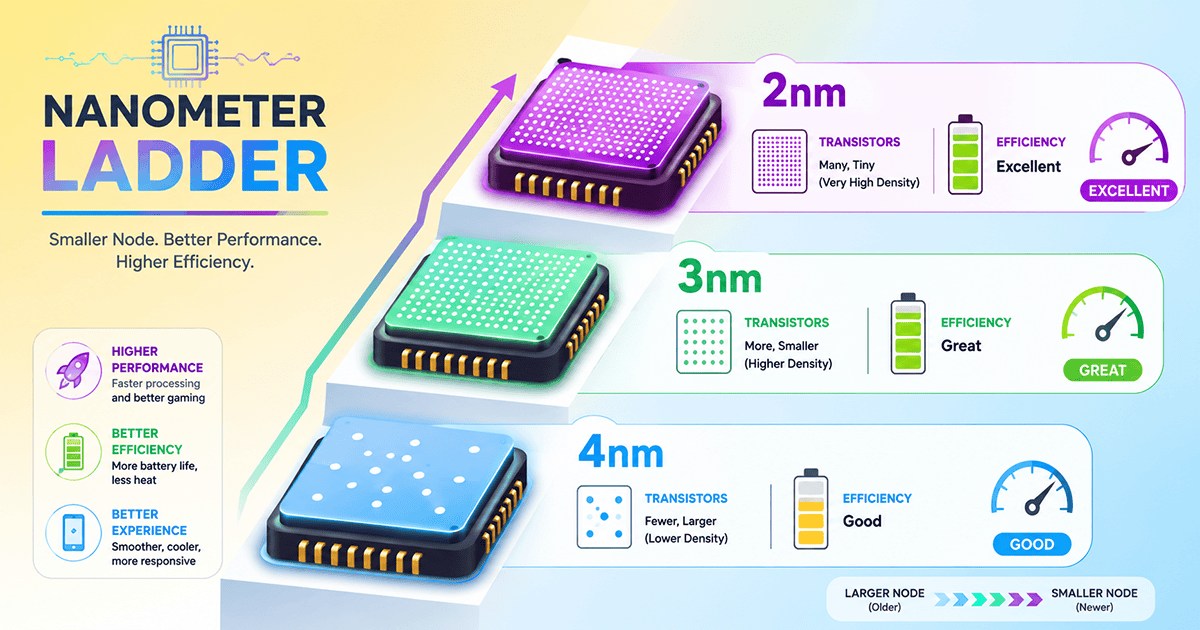
In the early days of the nanometer era, the number represented the actual physical gate length of the transistor inside the processor. The transistor is the tiny electronic switch that performs all the computational work in your phone. The smaller the transistor gate (i.e., the lower the nanometer number), the more transistors can be packed into the same area, increasing processing power.
However! Today, numbers like "3nm" are more of a marketing label than a precise physical measurement. Manufacturers like TSMC and Samsung use these numbers to denote an entire generation of technology, not necessarily a precise measurement of the transistor gate. This means comparing numbers across different foundries (e.g., TSMC's 3nm vs Samsung's 3nm) is not a fair or direct comparison.
📊 2. Quick Comparison: 4nm vs 3nm vs 2nm
| Feature | 4nm | 3nm | 2nm |
|---|---|---|---|
| Transistor Density | Baseline (reference) | Higher density | Highest density (billions of transistors) |
| Power Consumption | Reference | ~25-30% lower | ~25-30% lower (additional improvement) |
| Performance (same frequency) | Reference | ~10-15% better | ~10-15% better (additional improvement) |
| Key Technology | FinFET (traditional) | Enhanced FinFET | Gate-All-Around (GAA) – revolutionary |
| Example Phones | 2022-2024 phones | 2024-2026 flagship phones | 2026-2027 future phones |
⚡ 3. How Does the Manufacturing Node Affect Real-World Performance?
Improvement in manufacturing node doesn't necessarily mean a 3nm phone will be twice as fast as a 4nm phone in daily use. The difference is noticeable in specific scenarios:
🔹 In Heavy Gaming
Games like Genshin Impact or Call of Duty: Warzone Mobile consume massive power and push the processor to its limits. Here, the difference between 4nm and 3nm is noticeable. The newer 3nm processor will offer more stable frame rates (FPS) over longer periods because the heat generated is lower, reducing "thermal throttling." The improvement in power efficiency also means the phone won't drain the battery as quickly during gaming.
🔹 In Heavy Multitasking and Intensive Browsing
If you're a heavy multitasker—opening dozens of browser tabs, quickly switching between apps, or running design applications—the performance improvement (10-15% per generation) becomes noticeable. Moving from 4nm to 3nm or 2nm will make the phone feel noticeably smoother.
🔹 In Everyday Apps (Social Media, Calls, Messaging)
Here, the difference is almost negligible. Daily apps don't push the processor to its limits, so the difference between 4nm and 3nm may not be noticeable for the average user. Upgrading from 4nm to 3nm in this case will primarily show in battery life rather than performance.
🔋 4. Impact on Battery Life: The Real Difference
This is where the biggest benefit lies. Improving power efficiency is the primary goal of shrinking the manufacturing node. Smaller transistors require lower voltage to operate, reducing the overall power consumption of the processor. In practical terms, this means:
- Longer battery life during intensive use (gaming, photography, heavy browsing).
- Less heat during gaming or fast charging.
- Sustained performance for longer periods without thermal throttling.
🎮 5. What About Gaming? Will You Actually Notice the Difference?
The answer depends on the type of game you play:
- High-end graphics games (Genshin Impact, COD Warzone): The difference is very noticeable. You'll see less stuttering, improved frame stability, especially after long gaming sessions. The battery will also last longer.
- Light games (Candy Crush, Subway Surfers): The difference is barely noticeable. These games don't consume significant power, so you won't feel the difference between 4nm and 3nm.
- Competitive games (PUBG, Free Fire): Moderate difference. You might notice a slight improvement in frame stability when graphics settings are set to "high," but the difference won't be massive.
🔮 6. What Comes After 2nm?
With the arrival of 2nm technology, the industry enters a completely new phase using Gate-All-Around (GAA) technology. This allows better control over current leakage, increasing power efficiency and performance. After 2nm, the industry is moving toward technologies like 1.8nm (Intel 18A) and other technologies based on new materials like Nanosheet. The future will be even more exciting, but the benefits will gradually become less obvious to the average user.
✅ 7. Conclusion: Is Upgrading to a 3nm or 2nm Processor Worth It?
The answer depends on your usage:
- If you're a pro gamer or a heavy user of intensive applications: Moving from 4nm to 3nm or 2nm is worth it, and you'll notice improvements in performance, frame stability, and battery life.
- If you're a casual user (social media, calls, light browsing): You may not notice a significant performance difference, but you'll benefit from better battery life.
- If you're buying a new phone in 2026: Look for at least a 3nm processor, as it will be the new standard for flagship phones. 2nm will be reserved for future ultra-premium phones.