Gorilla Glass Guide: From First Gen to Victus 2, 7i & Armor 2 - Complete Guide
🛡️ Smartphone Screen Protection Glass: Comparison of All Corning Gorilla Glass Generations, Scratch Resistance, Drop Protection & Durability Tests
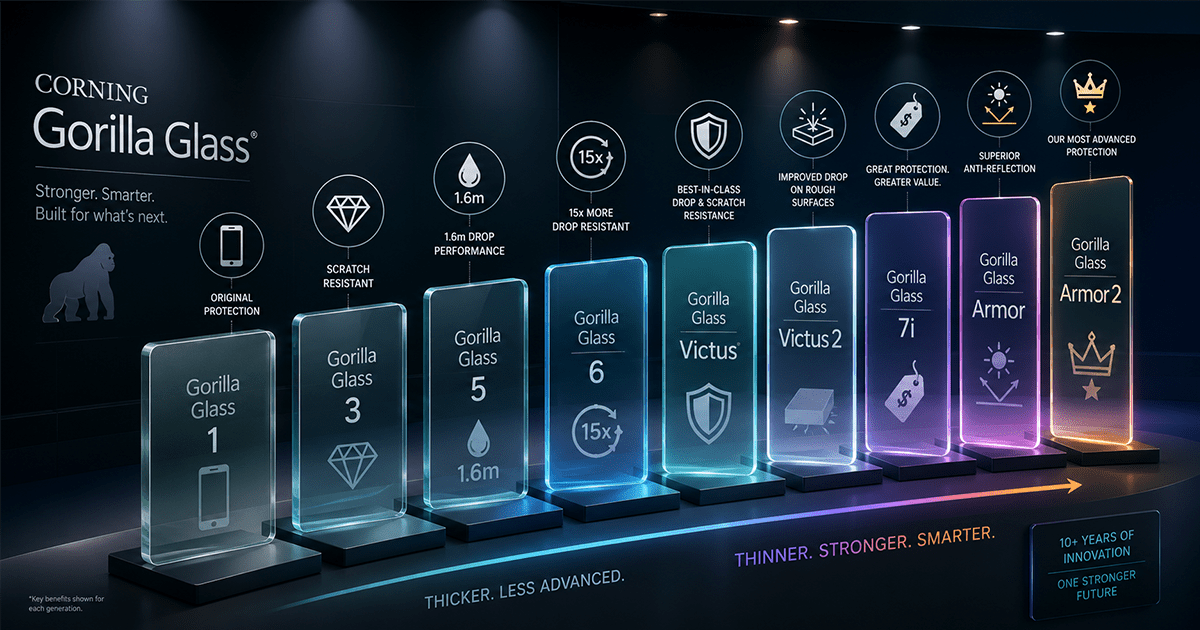
Your brand new phone is in your hands, its screen gleaming like a mirror. But what happens if it slips from your grasp onto concrete? Or rubs against your keys in your pocket? This is where the legendary Gorilla Glass comes in. From the first iPhone in 2007 to the latest 2026 flagships, Corning glass has protected over 8 billion devices worldwide. In this guide, we'll take you through the evolution of Gorilla Glass, from the original generation to the latest Victus 2, 7i, and Armor 2.
🧪 1. What is Gorilla Glass? (Manufacturing Technology)
The foundation is Aluminosilicate glass, a material combining aluminum oxide and silica. The secret lies in the Ion Exchange process, where the glass is placed in a bath of molten potassium salt at 400°C. Large potassium ions replace smaller sodium ions, creating a layer of compressive stress on the surface. This makes the glass significantly stronger and more resistant to scratches and impact.
📜 2. Evolution: From Gorilla Glass 1 to Gorilla Glass 6
🔹 Gorilla Glass 1 (2007-2012)
Debuted with the original iPhone. Thick (~1.5mm) but revolutionary, offering far better scratch resistance than plastic screens.
📱 Devices: iPhone (first gen), iPhone 3G, iPhone 3GS.
🔹 Gorilla Glass 2 (2012)
20% thinner (~1.2mm) with the same durability, enabling slimmer phone designs.
📱 Devices: Samsung Galaxy S III, Motorola RAZR.
🔹 Gorilla Glass 3 (2013-2018)
NDR (Native Damage Resistance) technology improved scratch resistance by 35-40%.
📱 Devices: Samsung Galaxy S4, S5, Note 4.
🔹 Gorilla Glass 4 (2014)
Twice as strong in drop resistance compared to GG3. Focused on preventing edge fractures.
📱 Devices: Samsung Galaxy Note 5, Galaxy S6.
🔹 Gorilla Glass 5 (2016)
Designed to survive drops from up to 1.6 meters (pocket height) with an 80% success rate on rough surfaces.
📱 Devices: Samsung Galaxy Note 7, S7 edge, OnePlus 5.
🔹 Gorilla Glass 6 (2018)
Designed for repeated drops. Survives 15 consecutive drops from 1 meter, twice as durable as GG5.
📱 Devices: Samsung Galaxy S9, Note 9, OnePlus 6.
⭐ 3. The Victus Era: The Generational Leap (2020-2023)
🔹 Gorilla Glass Victus (2020)
A massive leap: 2x better scratch resistance and 2x better drop performance than GG6. Finally balanced both protection metrics.
📱 Devices: Samsung Galaxy Note 20 Ultra, S21 Ultra, OnePlus 9 Pro.
🔹 Gorilla Glass Victus 2 (2022)
Improved formulation for drops on concrete surfaces from up to 2 meters. Ideal for heavier phones and foldables.
📱 Devices: Samsung Galaxy S23 Ultra, S24 Ultra, Pixel 7 Pro, OnePlus 11.
✨ 4. Latest Generations (2024-2026): 7i, Armor & Armor 2
🔹 Gorilla Glass 7i (2024)
Specifically designed for mid-range and value devices. Offers 2x better scratch resistance than competitors in its class and survives drops from ~1 meter onto asphalt-like surfaces.
📱 Devices: OPPO Reno 12, Xiaomi 17T Pro, and many 2025-2026 mid-range phones.
🔹 Gorilla Armor (2024)
Reduces reflections from 4-5% to less than 1% (75% reduction). Maintains Victus 2-level toughness while offering superior outdoor visibility.
📱 Devices: Samsung Galaxy S24 Ultra.
🔹 Gorilla Armor 2 (2025-2026)
The latest and strongest generation. Combines 4x better scratch resistance, 75% reflection reduction, and survival from 2.2 meter drops onto concrete. The first anti-reflective glass-ceramic for mobile devices.
📱 Devices: Samsung Galaxy S25 Ultra, Galaxy S26 Ultra, Galaxy S27 Pro.
📊 5. Comprehensive Gorilla Glass Comparison Table
| Version | Release Year | Key Features | Drop Performance |
|---|---|---|---|
| Gorilla Glass 1 | 2008 | Pioneer, better than plastic | Basic |
| Gorilla Glass 2 | 2012 | 20% thinner | Similar to GG1 |
| Gorilla Glass 3 | 2013 | 35% better scratch resistance | Good |
| Gorilla Glass 4 | 2014 | 2x stronger drop resistance | Improved |
| Gorilla Glass 5 | 2016 | 1.6m drop survival (80%) | 1.6m (80% success) |
| Gorilla Glass 6 | 2018 | 15 drops from 1m | 15 drops from 1m |
| Gorilla Victus | 2020 | 2x scratch & drop | 2m (improved) |
| Gorilla Victus 2 | 2022 | Optimized for concrete | 2m on concrete |
| Gorilla 7i | 2024 | Mid-range optimized | ~1m on asphalt |
| Gorilla Armor | 2024 | 75% reflection reduction | Similar to Victus 2 |
| Gorilla Armor 2 | 2025-2026 | 4x scratch, 75% less reflections, 2.2m drop | 2.2m on concrete |
🆚 6. Competing Alternatives on the Market
Corning is not the only player in the market, but it is certainly the most widely used. Here are the main competitors:
- 🍏 Apple Ceramic Shield: Developed by Apple in collaboration with Corning. It uses nano-ceramic crystals to improve durability and is claimed to be up to 4 times stronger than conventional glass. (Available on iPhone 12 and later models).
- 🐉 Dragontrail (AGC): A competing Japanese glass that has provided excellent protection in smartphones from brands such as Sony and Xiaomi, especially in the mid-range segment, although it is less common than Corning glass.
- 🏔️ Kunlun Glass (Huawei): Developed by Huawei for its flagship smartphones, such as Mate 50 Pro and Mate 60 Pro. It is claimed to offer exceptional drop resistance.
✅ 7. How to Choose Based on Glass (2026 Buying Guide)
- Flagship Phones: Look for Gorilla Armor 2 or Victus 2. Armor 2 is the absolute best in 2026 for ultimate protection with outdoor visibility.
- Mid-Range Phones: Gorilla Glass 7i or Victus are excellent choices representing a major leap in this price segment.
- Budget Phones: GG3 or GG5 are still far better than regular glass.
- General Advice: Even the strongest glass (Armor 2) can break with an unlucky fall. A good screen protector remains the best investment for protecting your expensive device.