
What is On-Device AI in Smartphones? How It Works Without Internet - Complete Guide
🧠 How AI Works on Smartphones: On-Device AI vs Cloud AI Explained and the Key Differences
Imagine your phone instantly translating conversations, summarizing meetings, and even detecting fraud — all without ever sending your data to the internet. This isn't science fiction; it's "On-Device AI," one of the most important technological revolutions in smartphones in 2026. In this comprehensive guide, we'll explain what this type of AI is, how it works away from the cloud, what its benefits are, and where you can find it in your phone.
🧠 1. What is On-Device AI?
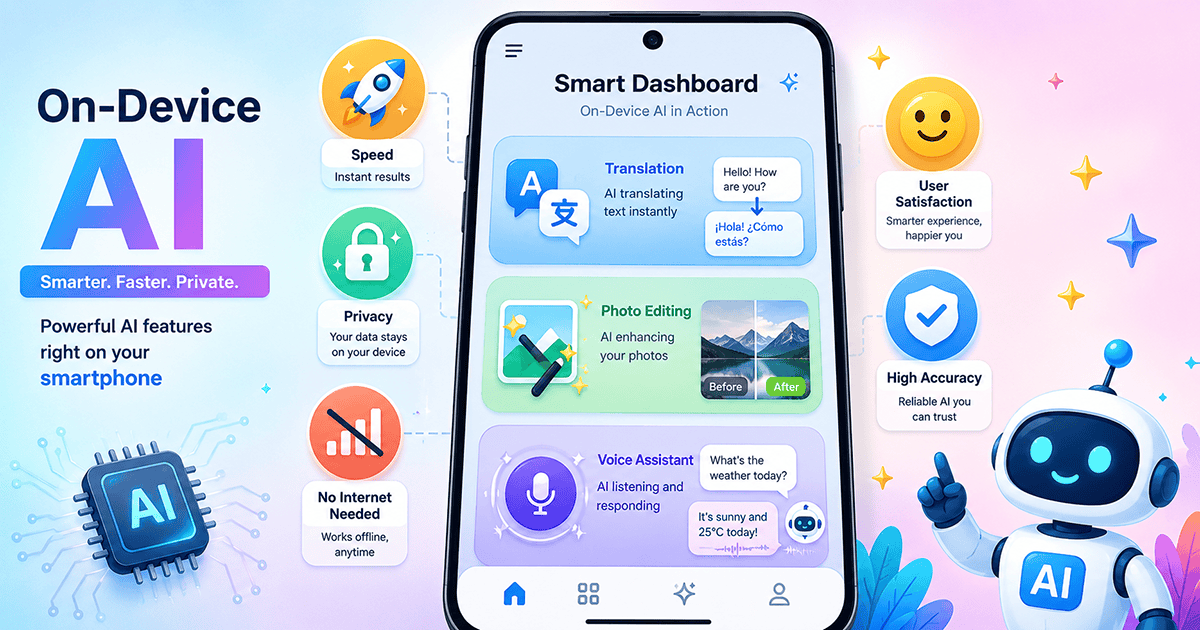
On-Device AI is the ability of your phone to perform artificial intelligence tasks (like translation, summarization, image recognition, or smart replies) using the phone's own processor, without needing to send your data to remote servers over the internet. It is a "digital brain" that works inside your own device.
Unlike cloud-based systems like ChatGPT that rely on massive servers, local AI models operate within the confines of your phone's capabilities. This doesn't mean they are less useful—they are specifically designed for tasks that require high speed, complete privacy, or offline operation.
⚙️ 2. How Does On-Device AI Work Without the Internet?
On-Device AI relies on three key elements working together to provide this seamless experience:
🔹 Small Language Models (SLMs)
Instead of massive models that require giant servers (like GPT-4 with trillions of parameters), phones use "miniature" models containing a few billion parameters (e.g., 1B, 2B, or 3B). These models are smaller and less memory-intensive, allowing them to run on the phone's processor. However, this small size comes with trade-offs: responses may be less detailed or less capable of handling complex tasks compared to cloud-based models.
🔹 Neural Processing Unit (NPU)
This is your phone's "secret weapon." The NPU is a specialized processor designed specifically to accelerate AI and machine learning tasks with high efficiency and low power consumption. Instead of overloading the CPU or GPU, the NPU handles AI tasks like image processing, voice recognition, and language model inference, saving battery and improving performance. In 2026, flagship NPUs deliver over 75 TOPS (Trillion Operations Per Second), enough to run 10B-parameter models on-device.
🔹 Quantization
A process that reduces the precision of the numbers representing the model's weights (e.g., from 32-bit to 4-bit or 8-bit). This significantly reduces the model's size, making it suitable for the phone's limited memory while maintaining acceptable performance.
📱 3. Where Do You Find On-Device AI on Your Phone?
On-Device AI is no longer a future technology; it's part of your daily experience on many modern smartphones:
🔹 Google's Gemini Nano on Android
Google's AICore platform, available on Android 14 and later, manages the Gemini Nano model, a small language model designed specifically for phones. This enables tasks like advanced spell-checking, speech recognition, detecting fraudulent messages, smart replies in messaging apps (like WhatsApp via Gboard), summarizing voice recordings, and instant translation. All these tasks happen entirely on your device, meaning your data never leaves your phone.
🔹 Apple's Core AI and Foundation Models
At WWDC26, Apple announced Core AI—a new framework for generative AI workloads, alongside its Foundation Models framework which provides access to a ~3B-parameter on-device model that powers Apple Intelligence. The new `@Generable` Swift API lets the model fill your Swift types directly, solving the classic "how do I reliably structure LLM output?" problem at the framework level.
🔹 Samsung's Galaxy AI
Samsung offers a hybrid approach: some Galaxy AI features work locally and some use the cloud, but you can choose to block cloud processing entirely. Features like Audio Eraser and voice note transcription can run completely on-device on newer models like the Galaxy S25 Ultra, with older models like the S23 Ultra having more limited local capabilities. Samsung claims all on-device data is processed behind the Knox security layer.
🔹 Open Source Solutions
Apps like PocketPal AI allow you to download and run hundreds of open-source models from HuggingFace directly on your phone, completely offline, with zero data transfer and complete privacy. The open-source `llama.cpp` + GGUF combo is already proven in production on both iOS and Android, allowing quantized models from Qwen, Llama, Gemma, and Phi to run at fluid token speeds on current flagships.
⚖️ 4. On-Device AI vs Cloud AI: A Quick Comparison
| Feature | On-Device AI | Cloud AI |
|---|---|---|
| Internet Requirement | Works offline | Requires internet connection |
| Speed & Latency | Instant (no network delay) | Depends on network quality (may take seconds) |
| Privacy & Security | Data stays on device, complete privacy | Data sent to servers, potential security risks |
| Model Capability | Small models (up to 3B-10B), less detailed | Massive models (hundreds of billions of parameters), advanced capabilities |
| Cost | No operational cost (no per-request fees) | Per-request (API) cost or subscription |
| Battery Impact | Optimized (thanks to NPU) | Does not consume the device's battery |
🛡️ 5. Privacy and Security: Why It's the Safer Choice
The most significant advantage of On-Device AI is privacy. In a world where data leaks are increasingly concerning, this type of AI provides unparalleled protection. Your data (conversations, photos, voice recordings) stays on your phone and is never sent to external servers.
Samsung's Personal Data Intelligence tracks everything you do on Samsung apps (calendar events, contacts, call logs, messages, photos, health data, location, app usage) to learn about you and offer suggestions. Samsung claims all this data is processed on your phone behind the Knox security layer, but users who don't want to risk it can disable this feature. For enterprises, this means being able to use AI with sensitive data without fear of leaks or surveillance .
✅ 6. Conclusion: Is On-Device AI the Future?
On-Device AI is not a replacement for cloud-based models—it's a complementary technology. Each has its ideal domain: cloud excels at complex tasks requiring massive models, while on-device excels at speed, privacy, and offline operation. The latest trend is "hybrid AI," where a local model handles quick tasks (like smart replies) and calls the cloud for more complex queries (like specific information retrieval). This hybrid approach can achieve 97.9% of a cloud-only solution's accuracy at just 17.5% of its standard API costs.
With increasingly powerful phone processors and more efficient small models, On-Device AI is expected to expand massively in the coming years, becoming an integral part of every smartphone, giving users complete control over their data and unprecedented speed in response.