Wired vs Wireless Charging, Qi2 & MagSafe: Which Is Best for Your Phone? - Complete Guide
⚡ Qi Wireless Charging vs Apple MagSafe vs Wired Charging: Standards, Speed and Key Differences Compared
Charging your phone is no longer just about plugging in a cable and waiting. With the rise of magnetic wireless charging and the evolution of standards like Qi2 and MagSafe, we now have multiple options, each with its own advantages and drawbacks. Is wired charging still the fastest? Are Qi2 and MagSafe the same? And which is the best choice for your daily routine? In this guide, we break down each technology and reveal the key differences to help you make the right decision.
🔌 1. Wired Charging: The Traditional Power and Speed
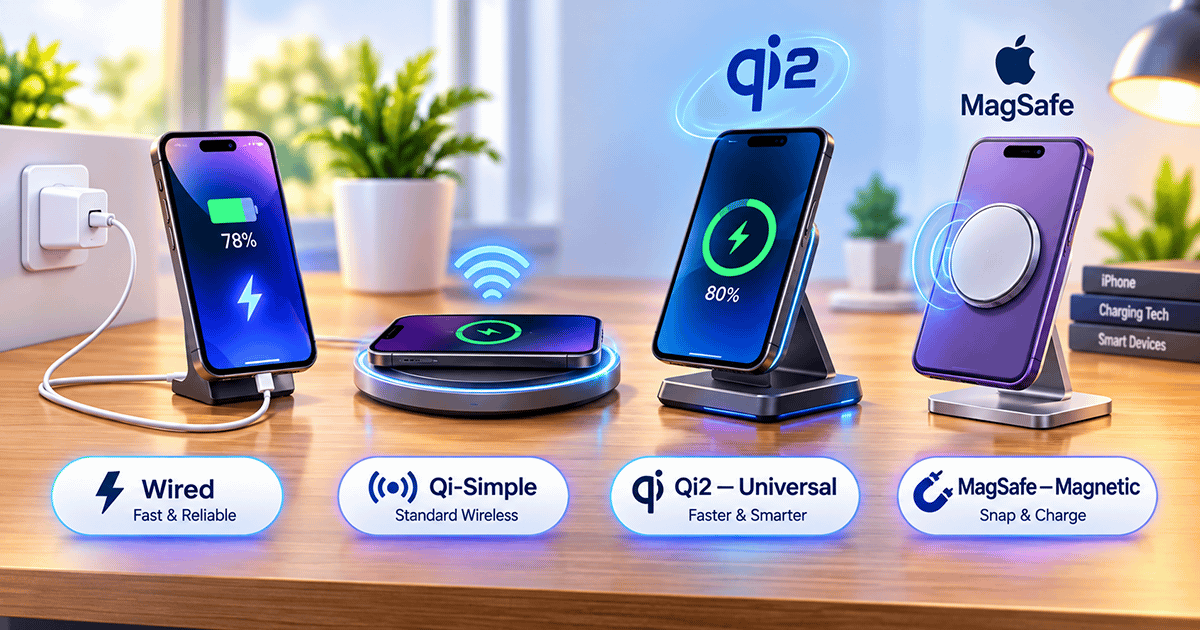
Wired charging is the method we are all familiar with. It relies on a direct cable connection between the charger and the phone, allowing for very high energy transfer efficiency. This is why wired charging remains the fastest and most efficient option today, especially with phones that support fast charging at 45W, 67W, or even 100W and beyond.
Pros: Blazing speed, high energy transfer efficiency, relatively lower heat, and lower cost for chargers and cables.
Cons: Requires a cable, and can be less convenient if you want to charge your phone quickly and frequently.
📡 2. Traditional Wireless Charging (Qi): The Beginning
Traditional wireless charging, known as the Qi standard, relies on placing the phone on a charging pad. While convenient, it is often slower than wired charging and suffers from "misalignment" between the phone and the pad, which reduces charging efficiency and generates extra heat.
🧲 3. MagSafe: Apple's Magnetic Revolution
Apple introduced MagSafe with the iPhone 12 in 2020. The brilliant idea was to add a ring of magnets around the wireless charging coil in the phone. This ring allows the charger to snap perfectly into place, solving the misalignment problem and ensuring higher energy transfer efficiency.
Speed: MagSafe started at 15W, and with Qi2.2 updates, some newer iPhones can reach 25W wirelessly.
🌐 4. Qi2: The Open Standard That Unifies the World
Qi2 is essentially the "open version" of MagSafe. In 2023, the Wireless Power Consortium (WPC) developed the Qi2 standard based on the MagSafe technology that Apple shared. This means Qi2 uses the same magnetic alignment principle but is available to all manufacturers, not just Apple.
Speed: The base Qi2 standard supports 15W charging, while the newer Qi2.2 version supports up to 25W, matching MagSafe.
Compatibility: This is the biggest advantage. A Qi2 charger can charge any phone that supports Qi2, whether it's an iPhone or an Android phone like a Pixel or Samsung (with a magnetic case).
🆚 5. Head-to-Head: Which Is Faster and More Efficient?
To understand the differences practically, here is a table summarizing how each technology performs in the most important aspects:
🎯 6. Which Is Best? (The Answer Depends on Your Needs)
There is no absolute "best" option. The decision depends on your priorities:
- If maximum speed is all that matters: Wired charging remains king. Nothing beats plugging in a cable to get the highest possible wattage in the shortest time.
- If you want maximum convenience with good speed: MagSafe (for iPhone users) or Qi2 (for everyone) are the ideal choices. You can simply place your phone on the charger without thinking about cables, while getting wireless speeds up to 25W, which is enough to charge most phones at a reasonable pace.
- If you use a modern Android phone: Look for a phone that supports Qi2 or a Qi2 charger. This gives you the benefit of magnetic alignment and 15–25W speeds without being tied to a single brand.
Final Tip: Wireless charging generates more heat than wired charging, which can affect battery health over the long term. Therefore, it is best used for convenient daytime charging, while relying on wired charging when you need a quick top-up or want to preserve your battery.